Featured post

Follow our travels

If you want to see where we've been, you can use this interactive map. Click on the markers to see more about where we have spent the ni...

Wednesday, 24 July 2019

On the doorstep of Norway


188 miles from Oslo, and 52 years since driving on the left
Tonight you find us in probably the best wild camping spot, ever, waiting out the 24 hours between the spaniels’ visit to the vet for their worming treatment, and the earliest time after that we can cross the border to Norway. In the past two days we have crossed Sweden from east to west, watching the scenery grow wilder and signs of human life grow sparser. Motorhomes are a regular feature of traffic coming towards us, many will be returning from Norway. Sometimes when we wave you see eyes flick across to register that we are right hand drive, and I wonder how many Swedes remember when they drove on the left. The whole country changed sides overnight on H-day, 3rd September 1967, when road signs, lines, junctions, everything suddenly worked the other way around. That must have been a fun few days!

We left Stockholm yesterday after taking the pups for a walk along one of Sweden’s ubiquitous cycle/footpaths through a meadow, a housing estate and a block of flats, until we reached the picnic area for residents of the flats. It was a great oasis in the suburbs, and it was indication of how warm it was getting that Elsa was faced with an expanse of green and didn’t ask for her ball. 

After that it was straight to Karlskoga, where an appointment had been made with a vet early this morning. We took the opportunity to do a big shop in Lidl, as food prices will be much higher in Norway. Unfortunately, the lovely motorhome site in Karlskoga was full by the time we arrived at 4pm. Hardly surprising as all the beautifully manicured spaces look out onto the lake. However, we saved ourselves fifteen quid by overnighting in the car park behind, and using the services in the morning. 

Barbecue night!
By 0830 we were at the vet, where Max and Elsa were weighed, had their chips read, and were given worming tablets. Passports duly stamped and signed by the vet, they were clear to cross the border to Norway between 24 hours and 5 days after taking the pills. It’s exactly the same procedure as we go through when we bring the dogs home from France, and just under £35 for each dog was about what we would expect.  

The early start had prevented a proper walk, so we headed back to the lake. The temperature was already climbing rapidly and both dogs were keen to get in the water. The presence of ducks prevented us from letting Max off the lead, so we tried to play a brief game of ball on the eight meter retracting leads. The problem is, Elsa struggles to get her mouth around the ball when she’s swimming, and it tends to bob away from her. This time it bobbed further and further. Elsa swam further, and I walked further out into the lake after her, in my shorts and sandals, holding my bum bag and phone up out of the water. Still she couldn’t get her mouth around it. Eventually I had to call her in, return to shore to leave my valuables, and wade out to the ball. By this time it was out of my depth, and I commend the elderly lady sunbathing on the shore for not blinking an eye at the sight of me swimming out to retrieve a £2.50 rubber ball, fully dressed, and wearing a straw hat. 


After a quick change in the van, it was off to the off-licence for a couple of boxes of wine, and to Willy’s supermarket for ice-cream to go with the delicious Swedish strawberries we’re finding on sale everywhere at the moment. By lunchtime we were ready to relax in the sun in this wonderful spot, 700m off a minor road down a gravel track. (N:59.3877639 E:12.0997356) We have it to ourselves. Thanks Park for Night, you did us proud with this one.


Now this is a wild camping spot

Monday, 22 July 2019

Death metal, meatballs and Salander

We enjoyed a quiet night on our campsite by the lake. It gave us the opportunity to take the spaniels down to the water in the morning for a game of ball. Then it was back on the road as we continued the journey North East. First stop was Växjö the birthplace of our old friend Carl Linnaeus along with a number of other famous names including Stefan Johansson the F1 driver.  The city is set on a lake, one of hundreds in that part of Sweden, so we thought it was an ideal place to walk the spaniels and allow them a bit of swimming, albeit on a lead. 
The lake at Växjö was a big attraction


Then we left them in the van so we could pay a visit to the emigration museum, which tells the story of Swedish emigration to the United States in the 19th and early 20th centuries. An amazing 30% of the population of Sweden emigrated during this period to escape the poverty and deprivation of what was then, a very poor country. Having become familiar with the stories of emigration from Cornwall and Ireland during the same period many of the tales told in the museum were familiar, but it was fascinating to read them from a Swedish viewpoint. One parallel with Ireland was the fact that many rural Swedes, like the rural Irish, relied on potatoes for their main source of food. Like Ireland, Sweden was hit by a potato blight which further persuaded people to seek a new life overseas.

Buzz Aldrin was a famous visitor to the museum
One previous visitor to the museum was the astronaut, Buzz Aldrin whose Swedish grandparents had emigrated to Massachusetts in 1892. It was fascinating to read his story on the 50th anniversary of the moon landing. Charles Lindbergh, the flyer who made the first solo crossing of the Atlantic,  also merits a place in the museum as the son of a man whose family emigrated from Sweden to Minnesota in the 1860s. The text avoided mentioning Lindbergh's enthusiasm for Hitler and his part in campaigning to keep America out of World War II.

From Växjö we headed north east towards the lakeside resort of Granna, the home of polkagris, a kind of rock. It was invented by a widow named Amalia Erikkson in 1859 and, in appreciation of her efforts to launch this red and white striped sweet on the world, a statue of her stands in a prominent place in the town. We pitched up on a large motorhome site in the hamlet of Bunn which is populated mainly with the holiday cottages of middle class Swedes from the cities. 

That night we had what was the first rain we have experienced since leaving the UK on July 8th. Luckily it held off while we walked the spaniels in a nearby forest. We were also able to catch up on some laundry on the site. Unusually we found that use of the washing machine and dryer was free although we had to be nifty to grab the facilities before anyone else. 
Stockholm boats some impressive architecture
We had decided we must make Stockholm the following day although t was the best part of a three hour drive. Our progress along the excellent E4 motorway was not helped by the torrential rain which made driving difficult. Traffic was very busy with Swedes heading back to the capital after their weekend break. Eventually we fetched up in the Stockholm suburb of Älvsjö where an enterprising entrepreneur had taken over part of the car park for the Stockholmsmässan, a huge exhibition centre that isn't busy in the summer. It wasn't particularly picturesque, but it was fairly flat and had the services we needed. 
Statue of King Charles XIV John


Streets made for strolling
The Swedes like a bit of Goth
One bonus was that it was close to the SL city train system so we left Florence and set off with the spaniels for the ten minute journey into the centre of Stockholm. The city, built on a string of islands, was a revelation. 

Sweden was not involved in either of the 20th centuries two world wars and the old part of the city was intact. We wandered into the old town with its cobbled streets and eclectic selection of shops, cafes and restaurants. One shop had a huge display of vinyl records recorded by Swedish rock bands. Sweden is something of a centre for the various genres of metal music with some of the bands, including Ghost and Amon Amarth,achieving wider fame.

Sweden is also the home of Abba and it is difficult to avoid references to the band. The boats which ferry tourists around the city are named after famous songs such as Voulez Vous and Mamma Mia and, on our own trip the house by the river owned by Benny Andersson came in for special mention. We were also told that one particular area was known as the home of Millenium magazine and Elisabeth Salander, both made famous by Stieg Larsson in his famous novels about the girl with the dragon tattoo. 
Lunch was nice


We did manage to avoid the Abba museum for which I am eternally grateful. Lunch, at a lovely little restaurant in the old town, comprised meatballs and lingonberries (him) and fried pike (her) washed down with some local beer. We did like Stockholm. 

This Whitehaven-built ship, now a youth hostel, hasn't moved since 1949

Some lovely buildings line Stockholm's waterways
Narrow alleyways are a speciality


Friday, 19 July 2019

The Man from Älmhult


He was called Ingvar Kamprad, he started a furniture company when he was 17, and if you can honestly tell me you don't have anything it sold in your house, then you must be living on Mars. Today we spent the afternoon in the IKEA museum, and it was a fascinating introduction to Swedish history, the past of a company that most of us have bought from, and the progress of design over the past 70 years. 

We learned that a million people, almost a third of the Swedish population, emigrated between 1850 and 1915. We read about the push to develop better housing and social welfare after WWII, and about a five year old boy who bought matches in bulk from a Stockholm store and then sold them on at a profit. The need to furnish these new homes with cheap and modern furniture, and the entrepreneurial ambitions of young Ingvar come together with the foundation of a furniture store in Älmhult, 90 minutes north of Malmö, and the whole town now revolves around the brand. 

A 1970s room display. Yes it is on the ceiling
You may remember seeing obituaries for Ingvar Kamprad when he died last year. A fascinating man, with some brilliant ideas, well ahead of his time, and he has set up an incredibly convoluted foundation structure to ensure that IKEA profits can only be reinvested, or used for philanthropic purposes. His admitted youthful entanglement with a Swedish Nazi is not glossed over in the museum, he says it was the greatest mistake of his life. Whatever happened then, he appears to have wanted to make amends in later life. He also took his entire workforce on holiday to Mallorca in 1957, which must have been a bit of a first.

That man Linnaeus again
Of course, being an IKEA museum we went in there for half and hour, and got so engrossed in the displays that we stayed for two. Fortunately we managed to swerve the marketplace on the way out, and found Max and Elsa having a nap in the car park. They were tired after a lovely walk around Lund this morning, following cycle paths and public footpaths through fields of ripe wheat, along a river, through horse paddocks and back to the windmill. 

Sweden, like Scotland, has a deeply held belief in the right to roam, and the public value of land. It means there are footpaths everywhere, and that wild camping (in a tent) is encouraged. While motorhomes don't benefit from the same rights, there is a culture which allows us to spend a single night almost anywhere that is not private land or "off-road". We have yet to really test this, but were undisturbed last night at the windmill. 

We could have chosen to stay tonight in the IKEA car park, but decided to drive another 20 minutes into the forest, where we have found a small campsite next to a lakeside bathing area, which is costing us less than £8. For the first time since Germany we have had to pay for something with actual cash, so we had to fall back on Euros. Our host showed us the people on all the Swedish banknotes, which we've yet to use - Ingmar Bergman, Greta Garbo etc. And he told us we are ten minutes away from Carl Linnaeus' birthplace. It seems appropriate, just three weeks after we were in Shrewsbury at the birthplace of Charles Darwin, and a few months after we were at the home of Edward Jenner. Science is just as easy to find when travelling as art, if you look for it. 

Tonight's stopover

Thursday, 18 July 2019

Another long bridge, a windmill and a rather melancholy tale.


This evening sees us parked in a quiet little lane just outside the university city of Lund. We are now in Sweden, where at 23 degrees the weather is nothing like it was portrayed in The Girl With the Dragon Tattoo. We had the same experience in Copenhagen where, having watched The Killing, we had assumed it was dark all year around. We are sat next to a beautiful old windmill which ground corn here between the 1890s and 1950. Now, the grounds are a picnic area while the mill itself doubles as a cafe run by a local youth organisation, although it only functions as such for a few summer Saturdays a year.

This is the bridge where the body was found in The Bridge
We left Copenhagen for the very short drive to the Oresund crossing which takes the main E20 from Denmark into Sweden across the strait of the same name. It is neither as long, or as spectacular as the bridge at Storebaelt mainly because the first section from the Danish side runs through a 2.5 mile tunnel before emerging on the island of Peberholm.

The remaining 5 miles does cross a spectacular bridge, the longest combined rail and road bridge in Europe. With the two crossings, and the Channel Tunnel, it is now possible to drive from Lancashire to the Arctic Circle without going anywhere near a ferry, which suits me very well.

We overnighted in a marina, not far from the crossing which gave us a chance to amble into the small
Pretty stunning...the bridge is nice too
town of Limhamn, essentially a suburb of Malmo. You could still see the vestiges of what had once been a separate settlement but the neat houses and bungalows in the 19th and 20th century streets were surrounded by new-build apartments. One group of these, somewhat incongruously, had been built around the remains of an old factory which someone appeared to have forgotten to demolish.

There was little to detain us in the shopping centre other than our introduction to a Systembolaget, one of the chain of Swedish state-owned off licences. It turns out that only weak beer (less than 3.5% alcohol) and so called 'folk beer' can be sold in supermarkets. Stronger beer, wine and spirits is only available at the state outlets. Actually the range of wine they stocked was remarkably good and the prices comparable with the UK. I have to say I was intrigued by the idea of 'folk beer' which conjured up images of someone up in the frozen north, brewing up a mixture of reindeer droppings in a giant cauldron. I may be mistaken about this of course.

So much space, so little time
The next morning we visited a designated dog play area next to the marina.With temperatures
forecast to hit 18 degrees by 7 am we decided to get out early with the spaniels for a game of ball. We were prepared for the usual few square yards of turf but this one must have been at least 4 acres. The morning was only marred by a German Shepherd that picked up Max's ball and refused to return it even to his owner.  Twenty minutes was enough before both spaniels were seeking a shady spot so we headed back to the van for breakfast.
Bit of Tudor style in Lund

Avid readers of this blog will recall that we had arranged to pick up a new cover for our water heater outlet but despite being assured by the dealer that it would be with them by the time we got there it wasn't. Instead we drove to Lund, a lovely little city which boasts a major university, one of whose former students was the famous botanist Carl Linnaeus. It also has many old buildings and a street pattern dating back to the 14th century. The settlement itself is much older than that, so old in fact that it was actually relocated from a spot three  miles away by the Danish king Sveyn Forkbeard in around 990 AD. Presumably he preferred the view.
Lund is well worth a visit


By mid-afternoon, having heard nothing from the caravan dealer about our cowl cover, we decided to hang around in the area to see if it turned up tomorrow before we headed north. Hence our arrival at the quiet little spot where I am writing this. The only excitement has been the arrival of a police car containing three of Sweden's finest. They were very nice and polite polis. For some reason they spent a few minutes round the back of the windmill before disappearing again. One of them was also kind enough to find the sunglasses I had left on the picnic table.

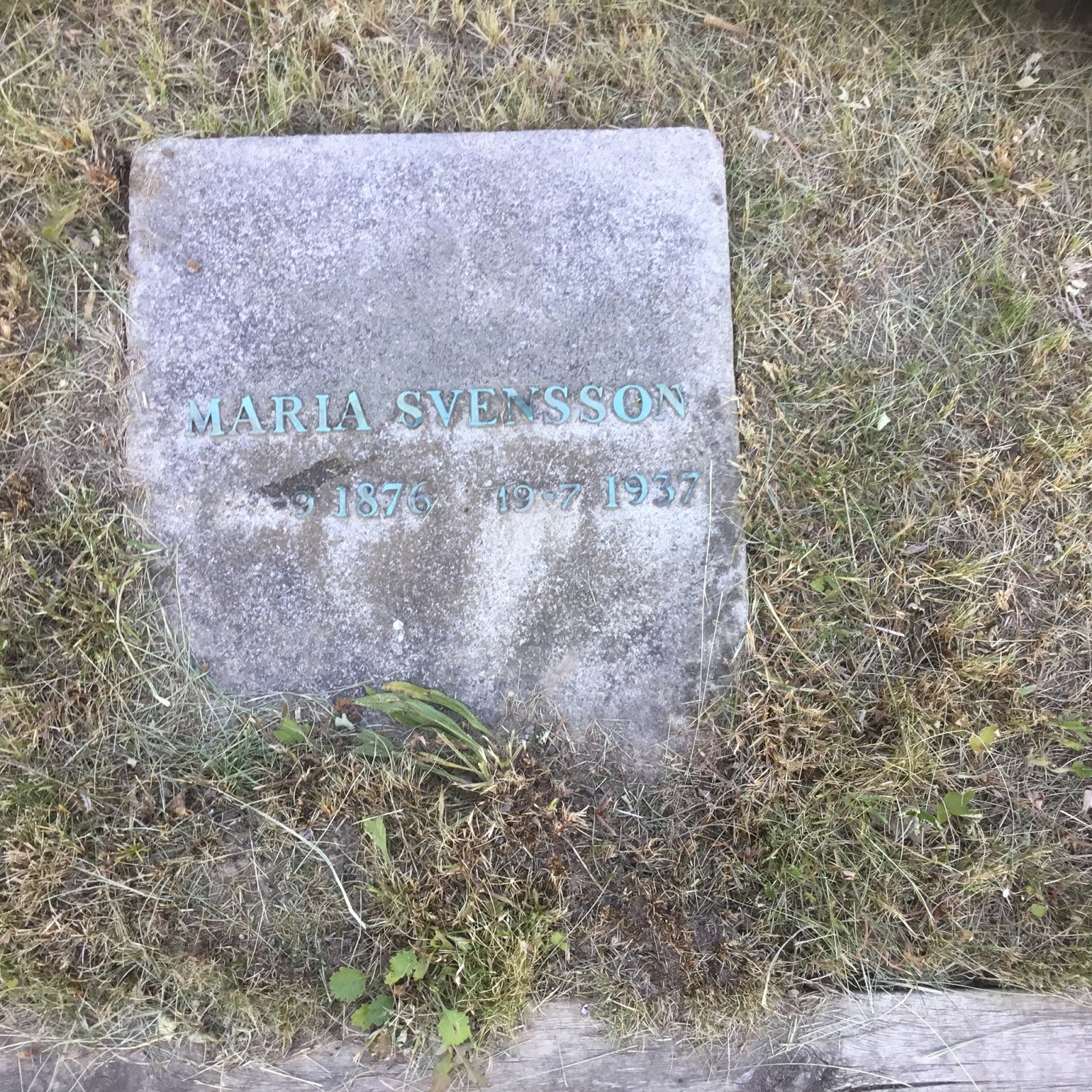
And finally, for the rather melancholy tale. Next door to where we have parked is an old cemetery which, for those of you who know me, is an ideal place to be. But this one is rather sad. It was set up to bury inmates from the local lunatic asylum at a time when the stigma of mental illness was such that they were not allowed to be buried in the town cemetery. The first occupant was Jennie Maria Ringstrom, who was interred on the 11th December 1895 after dying of consumption. She was 21.
The only memorials for the asylum inmates

Between her burial and 1950, when the cemetery ceased to be used, around 2,000 people joined her. There was little ceremony. They were carried to the grave in black coffins made in the asylum workshop. The only grave marker was a metal rod made by the local blacksmith with a top supposedly representing a bouquet of flowers, although it is now difficult to see that. 

 On  the marker was engraved the name of the deceased and their file number on the asylum books. Some relatives did put up headstones but these are rare. Most of the cemetery is overgrown although the middle section has been cut back so you can walk among the graves. Considering the backgrounds of the individuals buried there, it was quite a sobering experience. 


Tuesday, 16 July 2019

Copenhagen Day 2: headshops and street food


After walking through the central parts of Copenhagen yesterday, it was time to explore the canalised chic of the east. Tickets for humans and spaniels were duly purchased - Elsa and Max are considered children over 12 - and we emerged from the Metro at Kongens Nytorv. From here we strolled along the glorious technicolour of Nyhavn, almost missing the small plaque at number 20 which alerts the more observant that the ubiquitous Hans Christian Andersen wrote some of his tales here. 

At the end of Nyhavn a graceful series of bridges delivers you to Christianshavn, where the modern gin palaces give way to houseboats and day trippers, and a collection of shipping containers has been turned into a thriving plaza with street food worthy of a city boasting 15 Michelin starred restaurants. We had started early to protect spaniel paws from the hot afternoon which was forecast, so we decided to return nearer lunchtime. 

Recycled art in Christiania


First we wanted to visit the fabled Freetown of Christiania, a commune established by squatters in 1971, and still allowed to co-exist with modern Copenhagen, although Danish law is now enforced there and it continues to be controversial. Residents decided to evict dealers of hard drugs, and the prevailing culture supports only the use of soft drugs. Cannabis plants were growing at the side of the path, but there was a heavy police presence and tape across Pusher St. We were careful to observe the "no photos" signs on Pusher St, but enjoyed the colourful graffiti, the carefully constructed houses built from whatever came to hand, and the anarchic t-shirts for sale alongside the head shops in the little market. And since art is for appreciating, I managed a a discreet shot of a handsome wooden figure with a message for visitors. In Christiania, as everywhere else, the spaniels collected smiles, and water was offered several times. More members of their pre-teen fan club asked politely if they could stroke them - or so we must assume as the message was delivered gravely in Danish. When one child was gently advised to keep her biscuit out of the reach of questing noses, she dealt very effectively with the dilemma by shoving it all in her mouth at once. 

Christianshavn
Leaving Christiania, we wandered along the quays where warehouses are being gentrified, and brownfield sites are being landscaped to make the most of the views across the water to the city. Eventually our appetites dragged us back to the Inderhavnsbroen for some of the best street food available, courtesy of Palægade Smørrebrød, and Gasoline Grill. 

After lunch we walked back to the S-train, passing the famous Geist restaurant, the Kongens Have gardens where the scent of roses wafted through the air... and an Aldi. Always useful. The afternoon was spent relaxing at the water's edge back at our marina parking bay, enjoying the sea breeze and wandering periodically along the jetties to watch the boats in the harbour. Tomorrow we shall cross the Oresund bridge into Sweden, a privilege which will cost us more than £50, but save considerable time and diesel. I won't deny Nick the opportunity to tell you more about its construction later.

A spread from Palægade Smørrebrød

Monday, 15 July 2019

Mermaids, little girls and an 11 mile long bridge


A lovely walk with the spaniels along a public footpath between the sea and a golf course, (I hope we weren't responsible for the guy miscueing a shot into the rough as we passed by), then it was time for a trip to the local Aldi and the fun of deciphering Danish food labels. One plus point in Denmark is that fresh milk is a given, unlike most of France, Spain & Portugal where UHT reigns supreme. Then it was goodbye to Middlefart as we set off along the E20. 
Makes the Dart Crossing look a bit small
                                                                          The trip along the E20 took us over an engineering miracle, the 11mile long Storebælt bridge connecting the islands of Zealand and Funen. Essentially it's a box girder bridge to the small island of Sprogø in the middle of the seaway before the road soars over a massive suspension bridge, with the longest span in Europe. Before the bridge the only way to cross was via a ferry which took more than an hour. It is now doable in about 12 minutes, albeit at a cost of 245DK (£29) for the motorhome. We had decided that we would break the journey to Copenhagen in two as we wanted to arrive in the Danish capital early on the Monday morning, so we overnighted in a car park in Ringsted which, strangely, provided free electricity but no fresh water or toilet  dump.There had been four vans there when we arrived but a further three joined us late in the evening so we were quite a community. 


Terrible view
Monday morning saw a game of ball in a field next door to run some energy off the spaniels before we set off for the 60k drive to Copenhagen. We had hoped to stay in City Camp, a well known stopover close to Copenhagen centre. According to its website it had relocated but, after driving round the supposedly new location, all we saw were railway marshalling yards so we drove out to the Nordmolen Svanemollehavnen, a marina about 5k from the centre. In the event this was a great location as we managed to grab a space overlooking the harbour. We were glad we had decided to arrive early as by mid afternoon it was full.

Having parked up we walked the short distance to the nearest metro station, the pups had to have a child ticket each to travel, and went into Copenhagen centre which was very busy. The thought of going into the Tivoli Gardens was scuppered after seeing a) the high price and b) the 'no dogs allowed' sign. Instead we walked back in the general direction of the marina, using a series of parks to get off the road as much as possible. 


Two and two spaniels please
The walk took us to the Kastellet, supposedly one of the best preserved fortresses in Northern Europe. It formed part of the defence of the city when the Royal Navy bombarded it in 1807 in order to seize the Danish fleet to prevent it being pledged to Napoleon, Denmark being neutral at the time. In the event, Denmark did join the war on the side of the French, but contributed little as it no longer had a fleet. Luckily, we didn't meet any modern Danes who still held a grudge against the British for that little encounter.

Below the Castellet is Copenhagen's most famous landmark, the Little Mermaid, the amount of fuss about which is in inverse proportion to her size. The quay in front of her was packed, there was one of those gargantuan cruise ships in the bay and boats filled with tourists kept turning up to be told by their guides that this was the best part of their trip. That didn't really say much for the rest of their journey. 
Waiting for the British fleet to return
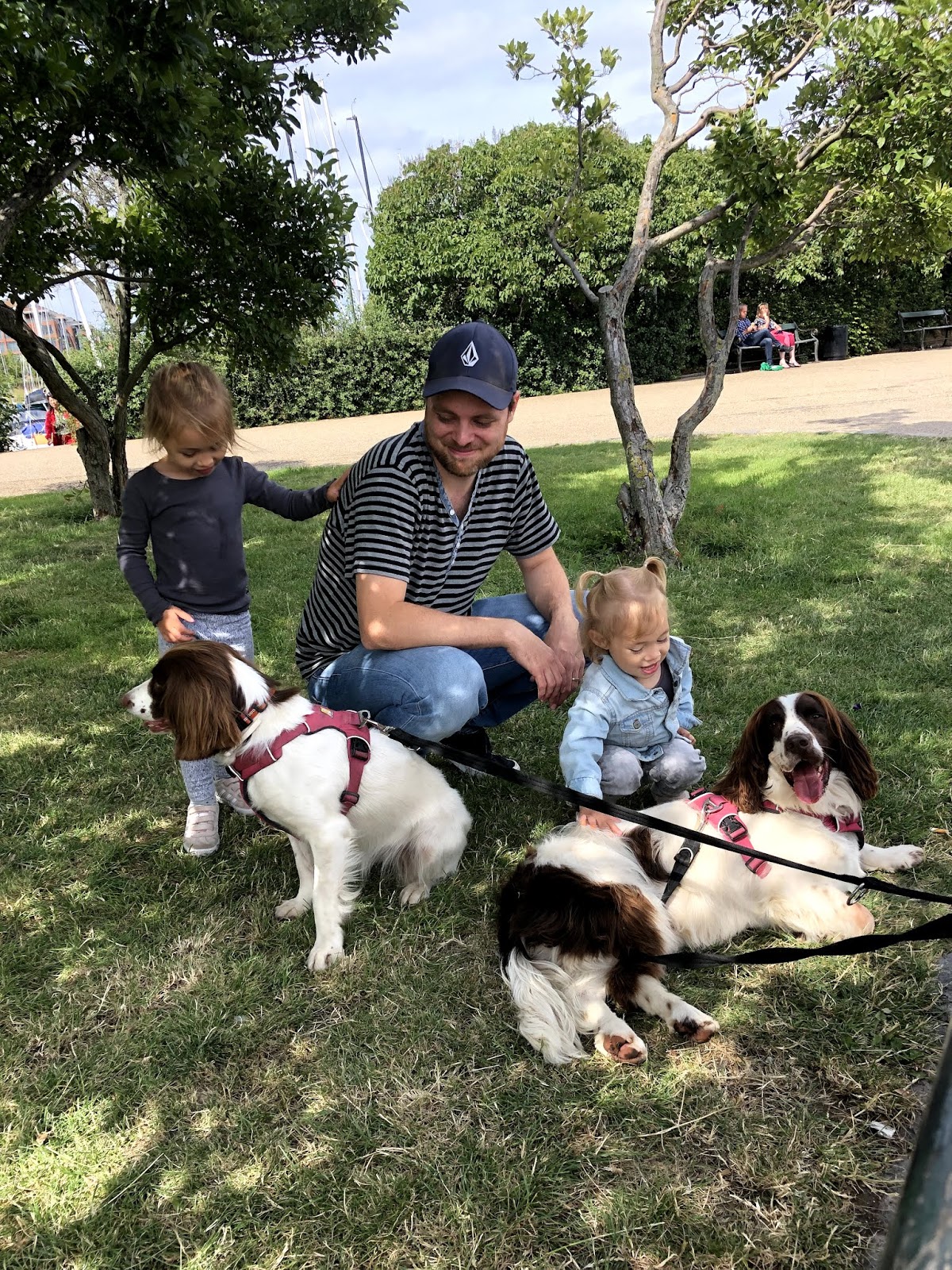
The other big attraction was Elsa who seems to specialise in collecting admiring little girls. While we sat on a bench sipping Carslberg, definitely nowhere near the best in the world,Elsa was holding court behind us ably assisted by Max who wasn't too sure what all the fuss was about but, nevertheless, played his role. 
The spaniels charming the locals

Eventually we managed to persuade her and Max to walk the rest of the way back to the marina, stopping only at a Netto for essentials (wine) and luxuries (milk). Given that both of them had covered more than eight miles of city streets, with all the smells and distractions, we thought they had done pretty well. 

Having had a fairly brisk journey over the first week of our travels we decided, despite the £30 a night charge, that the marina was worth a two day stay so we could do a little more exploring in Copenhagen. 

One other little occurrence was the loss of the plastic cover on our gas vent. However, a quick e mail to a dealer in Malmo has ensured that a replacement will be waiting for us when we arrive there on Thursday. 


That scaly female is in there somewhere


Saturday, 13 July 2019

Farting about in Denmark


Middelfart has been on the route plan for some time, for the simple reason that I identified it early on as our first laundry stop. The marina here has fully serviced motorhome spaces for about 15 vans, and it provides all the facilities needs by visiting yachts, including a couple of washing machines and dryers. We were so keen to make sure we got one of those spaces, that we were here by three o'clock, having crossed the border from Germany at about one, just in time for lunch. It had been a fairly dull and overcast morning, and there was a spell of heavy rain. But as we crossed into Denmark the sun came out, the sky cleared, and our first view of the sea was a breathtaking blue broken by the white sails of yachts bobbing about in the Lillebaelt (Little Belt) straight.
Elsa is working on her highlights

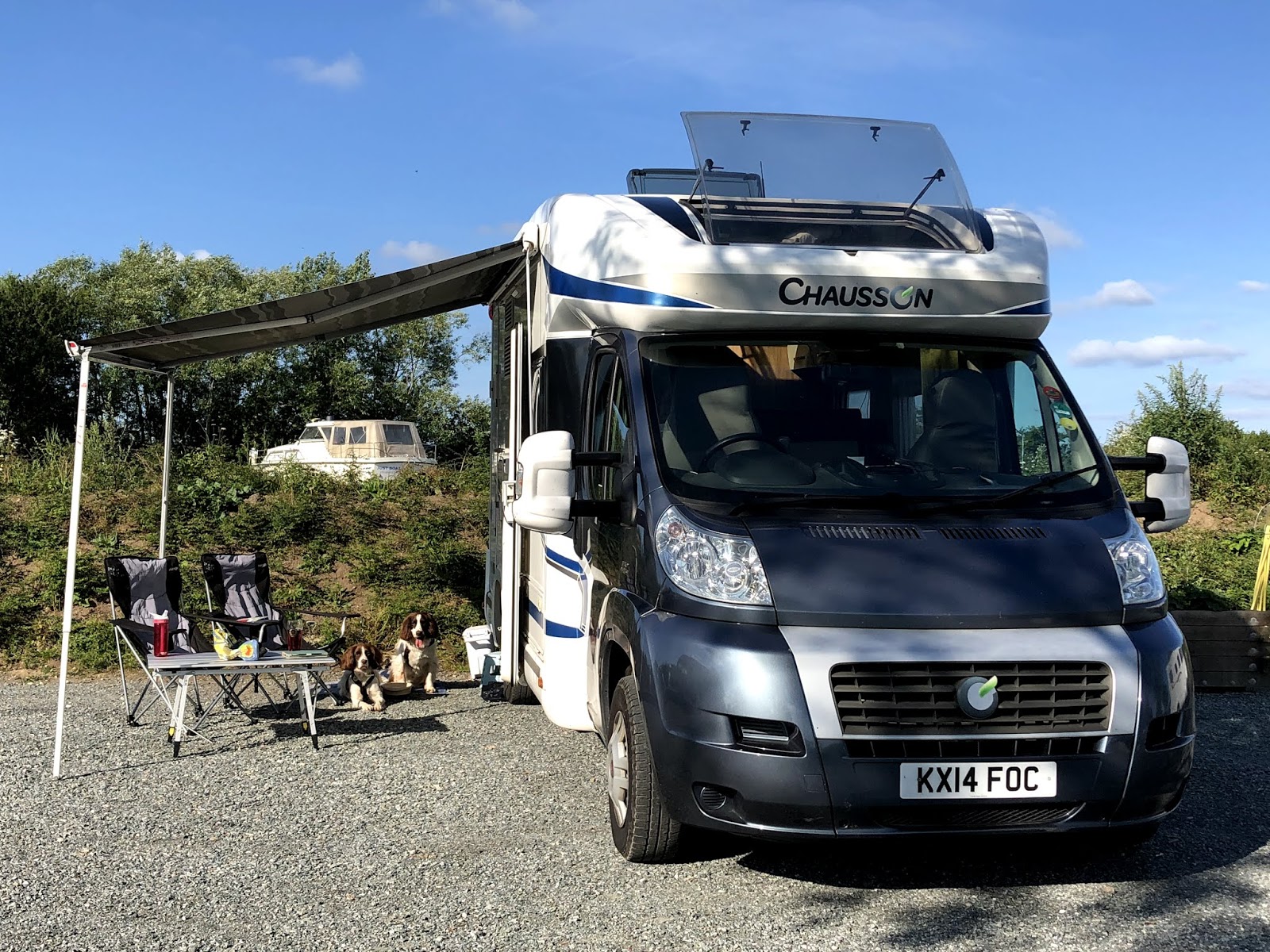
We found the marina without trouble, which left us little to do but unfold the chairs, feed the laundry to the washing machine, and peg out the spaniels. Or some combination of the above. We didn't even have to withdraw any Danish Krone - everything here is done by loading a plastic card, from the laundry to filling up with water.

Later we had a lovely chat with the neighbours, a Dutch couple with a teenage son, who are travelling a similar route to us as far as Bergen, but have only a month for their holiday. It was great to swap motorhome lore, van details, and information about travelling with dogs. And since he was wearing an All Blacks shirt, there was also some some discussion about rugby, which he had played for 25 years.
Ready to lounge in the sun


It's good to finally be in Scandinavia, although we enjoyed our three days in Germany, and are looking forward to spending more time there next spring - on the way back north. The landscape in the north is fairly flat, and parts of it were very industrial. But we founds lots of lovely places to walk the spaniels. This morning's walk was through a small forest in Neumunster, which opened out into a glade ringed by memorial stones to the local people who died fighting in the Second World War. It was simple and moving, started after the First World War, and continued and enlarged after the second. A large plaque in the centre of the circle called for an end to war and fascism. We are so used to seeing Commonwealth and Allied war memorials, but seldom see those of the other side. Their families want to remember their loss too, and most of the combatants were individually powerless. It's interesting that such a powerful memorial is hidden away in the forest, and it reminded me a little of the Katyn Memorial on Cannock Chase, where we were just a week ago. It seems very far away now.

One of many memorial stones in Neumunster