Featured post

Follow our travels

If you want to see where we've been, you can use this interactive map. Click on the markers to see more about where we have spent the ni...

Friday, 7 February 2020

The spaniels who came in from the cold


It is 8° outside right now.  Something of a shock when we’ve been used to temperatures of 15-18° for most of the last two months. We have decided to come into a campsite where we have endless electricity to power the fan on our heating, access to as much water as we need, and somewhere to dump the loo without having to worry. Our Christmas sojourn convinced us that a few nights staying still needn’t stretch the budget, and while we have always been year round motorhomers, there’s little to be gained from trudging around the coast in the cold when the warm weather promises to return in three or four days. 

We are now at Camping Argolic Strand, just south of Nafplio on the final Peloponnese peninsula - the eastern thumb. And if they happen to have good wi-fi on every pitch on a six-nations weekend, well that’s an added bonus. A bit of cleaning, some laundry, some nice long walks on the beach, a few episodes of University Challenge, and we’ll be ready for our final few weeks in Greece. 

Random tomb
The last few days have given us the chance to see some spectacular sights. 
We left Ancient Mycenae on Monday morning, after taking the spaniels for a walk through the olive groves and stumbling on a completely unmarked Mycenaean tomb just sitting in a field by the track. It’s a not-uncommon feature of our walks, Greece simply has too many ruins to adequately enclose, present and signpost them all.  

We were heading for Lidl on the outskirts of Argos, but double white lines prohibited us from turning left, and before we knew it we were back in the warren of streets in the town. The turnings offered by Google Maps to get us back looked, at best, dicey, so we decided to forge on to Nafplio, where another Lidl was much more accessible. On the way we passed the ancient city of Tiryns, a smaller version of Mycenae, with equally impressive stone blocks. The Cyclopes were evidently kept busy around here.

Shopping complete, we drove up to the vast Palamidi fortress which looms over  Nafplio from a 216m high outcrop. It’s possible to walk from the town, but we decided that 901 steps was just a tad too far. The citadel itself kept us busy for well over an hour with a maze of at least eight individual bastions within the walls. It was built in 1711 by the Venetians, and is now mostly in ruins, but would make a fantastic place for a treasure hunt. There are also fabulous views of the area, and I was glad I’d picked up the binoculars. 

Wonderful views


At last we drove back down the hill, and parked up in the port, where the row of motorhomes along the seafront numbered up to twelve while we were there. It’s a huge car park used by cars, tour buses and lorries, and our presence there seemed to be well tolerated. We were far enough away from the unloading cargo ship and refrigerated lorries for a fairly quiet night.

Palamidi at night

The old town
 The next morning we explored the peninsula which is the site of the lovely old town. It had the winding alleys and steep steps you’d expect from a Greek town, but with the pastel shades and balconied villas that betray a Venetian influence, and with a smattering of grand Neoclassical villas and landscaped squares which befits the newly independent Greece’s first capital in 1833. Smart boutiques rub shoulders with classy tourist shops selling gifts made from olive wood and leather, and ropes of the inevitable worry beads. There is even a worry bead - Komboloi - museum. The four of us wandered around until lunchtime, when we found ourselves at a harbour front cafe where we could sit in the sun, watch the comings and goings, and admire the view of the beautiful Bourtzi fortress on an island in the bay.

Bourtzi Fortress

In the afternoon we made individual forays into the town, and I ambled up to the last of Nafplio’s three fortresses, which sits above the old town. There is little left but the walls, and the sad remains of some apartments and restaurants, but it has wonderful views of the Palamidi fortress and the bay. We spent another night in the port, this time rather less quietly as strong winds blew up and rocked Florence on her wheels. 

A massive lion
 We survived the night unscathed and discovered a lovely walk under the cliffs where the spaniels could enjoy a loose lead and we could marvel at the change in the sea, which had gone from flat, blue and serene to wild, green and crashing on the rocks. Then it was time to leave Nafplio, with just a quick stop for a closer look at an extraordinary sight I’d caught out of the corner of my eye as we’d driven up to the fortress: a massive lion carved out of the rock near a cemetery. It turned out to be a memorial commissioned by King Ludwig of Bavaria to the troops who’d accompanied his son Otto to Nafplio when Otto became King of Greece. Many of them had died from typhoid. 

From there we drove to the small port town of Epidavros for a night in the harbour car park. The next morning we took the spaniels along a well marked trail to ancient Epidavros, a collection of ruins, and a small theatre, little brother to the one we were on our way to visit. A short drive later and we were at the vast site correctly known as the Sanctuary of Asclepius, god of medicine, but usually known simply as Epidavros. Just to confuse matters still further there is a third place known as New Epidavros just up the coast. 

A centre of healing
 Epidavros is best known for its astonishing theatre, built in the 4th century BCE, but still almost intact. Its acoustics are incredible, a whisper from the centre of the stage can be heard in highest rows. It is still used to stage performances, and can seat up to 12,000 people. But it’s only a small part of the site, which includes several bathhouses and fountains, temples, hostels, and a stadium. It was a centre of healing renowned across the Classical world. We enjoyed a ramble around but were happy to get inside the small museum, which had some impressive statues, but was also lovely and warm after the chill outside. We sat in Florence nursing our mugs of miso soup, and decided to head for a campsite. 


Monday, 3 February 2020

A bit of a clean and a coastal drive to ancient history


If you are going to end up accidentally driving around the narrow streets of a Greek town, it might as well be a place of some significance. Argos is such a place, one of the oldest continually inhabited settlements in the world. It is believed people were living here more than 7,000 years ago, although it is unlikely that Neolithic man would have found himself cursing Google maps for depositing him in a warren of one-way streets rather than the ring road which would have been a better bet. Eventually we managed to extract ourselves and get back on track. 
A little chilly at this height


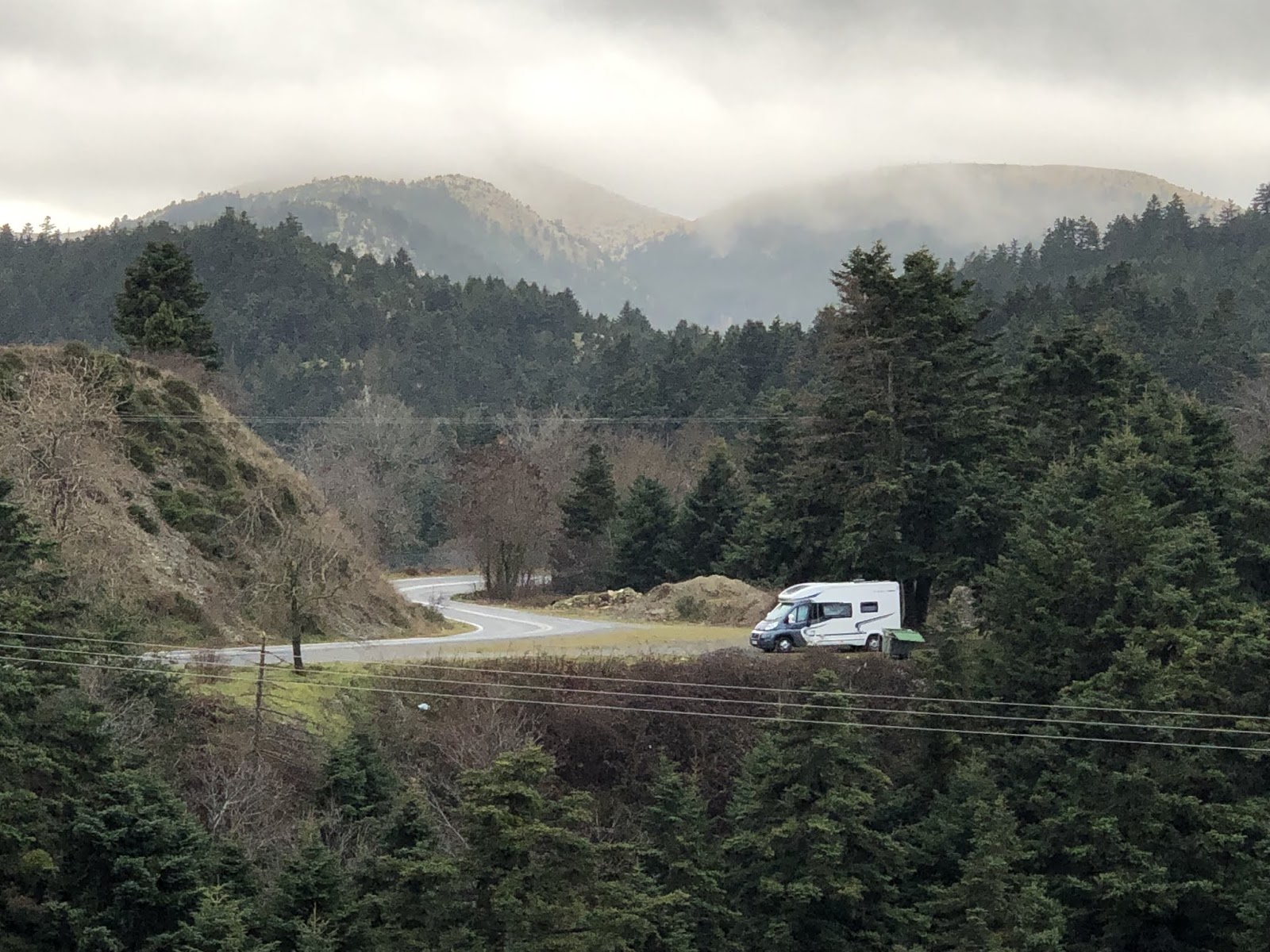
We had started this phase of our trip 4,000 feet up in the Parnon mountains near the village of Kosmas where we had spent a quiet night on a parking area. After being at sea level for so long it was a bit of a shock to experience cold mountain air. We took the spaniels for a walk along a rough track through the obligatory olive groves as the sun finally began to warm things up. 


Pausing on the way down
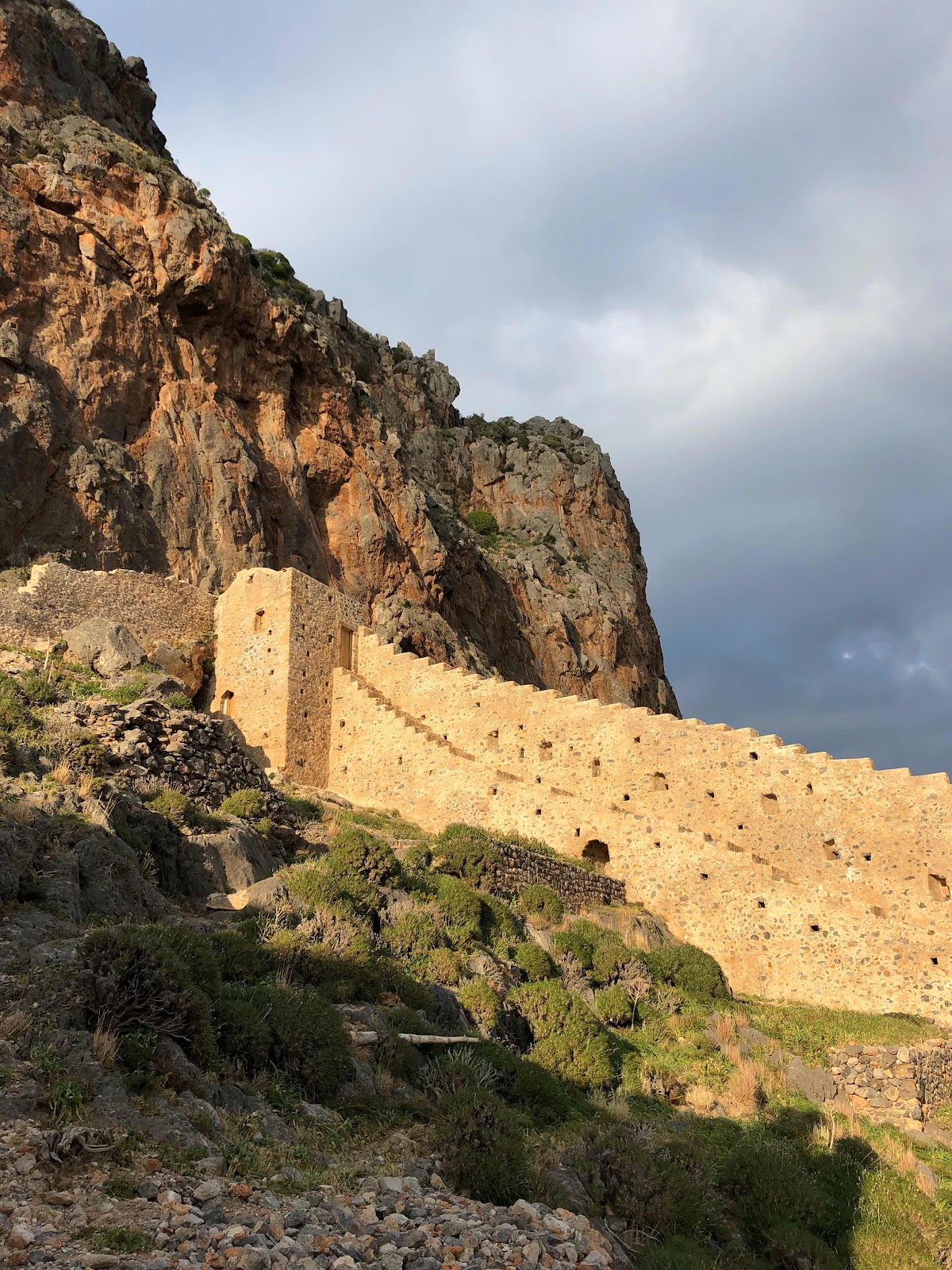
Given our height, and the fact we planned to be down at the coast that evening, we expected a fairly sharp descent and so it proved. A series of seven steep hairpin bends took us down through a spectacular gorge alongside a dried-up river bed. The long hot summer coupled with an extremely dry winter this year meant a sign promising white water rafting was unlikely to deliver. Having stopped to take a photograph of an old monastery clinging impossibly to a rock face, we finally reached sea level at the town of Leonidio. 
Builders needed a head for heights


We had to drive another 4k down the road at Plaka where our trusty Park4Night app had promised a flat area by a beach, and so it was. It was also busy with mainly home-built camper vans owned by climbers who relished the opportunity of tackling the mountain range behind us. When we went to eat in the small local taverna that evening we discovered a couple from Colorado who were spending a few weeks climbing in the area. Apparently Greece offers challenges that the Rocky Mountains don’t. They explained what that was but, as someone for whom climbing is only associated with stairs and bed, I struggled to get it. Something to do with ‘drips’ apparently.


Some places are worth two nights
The next day saw us journey on northwards along a winding coast road, rocky heights to our left and a sparking blue sea to the right. We had thought that Norway offered the most spectacular scenery in Europe but the Peloponnese can certainly give the Vikings a run for their money. Lunch was taken in the van, parked on a headland looking across to the small island of Spetse where, Neri told me, she had spent a week’s holiday some years ago. Further on we turned off onto a narrow side road which took us through even more olive groves to what was the most perfect small harbour with small blue and white fishing boats tied up at the quay. We quickly decided that this was a place for a two-nighter and an opportunity for a bit of a cleaning session. 

There was a river here once
We were out of bread and running low on milk so the following morning we decided to walk the 3k to the nearest village. Max is undergoing training to stop him dashing about when on the lead, so it took us a little longer than it might have to get to the tiny grocery shop. I also popped into the local bakery which had beautiful freshly baked loaves as well as the bewildering selection of pastry products which the Greeks seemingly cannot get enough of. On the way back we stopped to look at the remains of an old bridge that had once crossed what was now yet another dried up river bed. 


This was here long before the Ancient Greeks
Our destination on Sunday was the ancient site of Mycenae which was an hours drive away. We stopped at a roadside stall to stock up with oranges, 20 for less than two quid, and, having battled with Argos, climbed the hill to Mycenae. The car park was very busy, not least because there is free entry to historical sites in Greece on the first Sunday of the month. Greece is rich in archaeological remains but Mycenae, a UNESCO World Heritage Site, is a bit special. It’s origins go back 7000 years but it achieved prominence during the Mycenaean age to which it gave its name. This period predated the Classical Greek era and was the source of Homer’s poems about the Trojan War and its aftermath. We think of Alexander the Great as ancient history but Mycenae was flourishing a thousand years before the conqueror was born. 
This was old when Alexander was born


We climbed the hill to the top of the fortress which, at its peak, had been the centre of a settlement of more than 30,000 people. It is ideally situated to guard the approaches from all directions and it is easy to see why it became a seat of power. That power is exemplified in the stunning Lion Gate, the main entrance to the fortress on which is inscribed the outline of two lionesses, the only motif of Bronze Age Greece that was described in classical literature so modern archaeologists already knew of its existence. Tonight we are parked up a couple of hundred yards away, looking across at this amazing place. 


Wednesday, 29 January 2020

Modern Sparta, a Byzantine capital and a rare traffic jam


The truck driver waved us back from where he had been surveying the road ahead, and we pulled over against the wall of the village church to wait. He jumped into his cab and reversed towards us, revealing a large bus ahead. Then we realised the bus was also reversing, also towards us. What on earth was ahead? We soon saw. It was a huge curtain-sided truck with a trailer almost as big. The bus swung into a small square, the truck ahead of us tried to get down a side street, but realised it wouldn’t make it, so the truck and trailer crept back a few feet to allow him to sneak through the gap. We pulled into a small alcove, and the behemoth went on its way. 

It’s amazing we haven’t seen more such incidents in Greece, as the main roads often go through tiny villages with sharp turns, nasty overhangs, and room enough for only one vehicle. There are plenty of convex mirrors to help see around corners, but it can still be a little disconcerting. What’s made it so much easier is that there is so little traffic, and that Greek drivers are generally good natured and rarely in a hurry, especially in Laconia, from where we get the word laconic.  In the next village along we stopped to wait while a conversation between two drivers was concluded through open windows as they passed in the road. And they never give the impression that we shouldn’t be in their road, they just pull through the narrowest of gaps and go on their way.

Leonidas, hero of Thermopylae
 We were heading east from Sparta, climbing into the mountains which separate it from the sea, as we start heading north towards the Isthmus of Corinth. It was our second visit to Sparta in 48 hours. We’d arrived there on Monday, having had a lazy weekend in the small harbour town of Plitra, and at a quiet beach stop we’d used a few days before on our way to Monemvasia. It was ideally situated to do our weekly shop at the Lidl in Skala on Monday morning. Who should be in the car park, but a German couple in a Motorhome we’d seen back in Thessalonika, and then at Thermopylae, and again at Monemvasia. They are clearly doing a similar route, but they speak no English and our conversations have been friendly, but limited.


We were delighted to discover that Sparta has wide boulevards with a central reservation, making it easy to drive through the town to a side road where we could park up for the night, just around the corner from the ruins of the old town. In the morning we dropped off our dirty clothes at a laundry, before learning that Ancient Sparta is closed on Tuesdays. A quick replan, and it was off to the old Byzantine capital of Greece at Mythras, just twenty minutes outside Sparta.

Sparta from Mythras

The fortress at Mythras

The palace as you approach
We pulled into the lower car park just as a large white Unicat Motorhome drove in from the other end. It was our friends from Camping Finikes at Christmas! They had spent the night 2.5km further on at the top car park, and recommended we carry on up there, so we did, to the delight of two pairs of glutes faced with a very much shorter walk to the top of the fortress.


And from the other side


After lunch we explored the fortress and most of the upper town, deciding that was probably sufficient for one day. It was enough to see the fabulous construction of the innermost keep, high up in the top of the rock. From there we wandered down steep alleys, stepping into churches and ruined monasteries, and gazing at the immense restored palace built by sons of the Byzantine Emperor in Constantinople who had turned the Peloponnese into a despotate in the mid-fourteenth century. Below us were more beautiful monasteries, but we enjoyed the view and declined the trek down... and the inevitable return journey.


We spent a quiet night in the car park, taking the spaniels for a wander up the hill for more breathtaking views the next morning. Then it was back to Sparta to pick up the laundry and go for a brief wander around the old town. The laundry was beautifully cleaned and folded, two loads for €20, but to our amusement was several shades pinker than we had left it. How had we managed to wash Nick’s red t-shirt for six months without doing the same? 


Sparta’s old town has been pillaged too often to be more than a vague outline, but there is an impressive Roman theatre, some remains of early Byzantine churches, and a few bits of ancient temple. Entry was free, so we weren’t expecting more, but it was an enjoyable wander. Finally it was time to leave the province of Laconia and return to Arcadia. We are spending the night in a quiet lay-by in the mountains, where to our great surprise, my altimeter tells me we are at 1199 metres - almost 4000 ft. More hairpins tomorrow then. 

The theatre in Sparta

Saturday, 25 January 2020

A very long beach and a prehistoric burial site


Greece has some of the world’s finest historic sites, stretching back through antiquity. However, as we found when we visited Ancient Messina, the authorities are remarkably relaxed about letting visitors have access to them. So, where in the UK you might find barriers and notices warning you to keep off, the same does not apply in most of Greece. We therefore found ourselves standing among a number of ancient graves which had been carved out of the rock close to the sea near Neapoli with not a thing to stop us wandering all over the area.

We had walked to the site along what was probably the longest beach we had seen so far in Greece....and it was completely deserted. We discovered it was also one of the main nesting grounds of loggerhead turtles although, regrettably, we were too early in the year to see them.  Our wander had been enlivened, although not in a particularly good way, by Max’s decision to set off again on one of his marathon swims. Thus it was we spent a great deal of the outward walk anxiously watching the head of a spaniel bobbing in the waves at least 50m from the shore. He is a strong swimmer but his tendency to completely ignore our calls for him to come back in are frustrating to say the least. He did eventually return, and spent the rest of the walk on a lead.
The longest beach so far


The dead are long gone
We were standing on the shore looking across the short distance to the small island of Elafonisos. Under the sea in front of us we could see some of the remains of the city of Pavlopetri, which was built during the Mycenaean period between 1600 and 1100 BC. 

It was destroyed by an earthquake around 1000 BC, an event that also severed the island from the coast. Through the clear sea water it is possible to see some of the remains of the settlement. On the rocks where we were standing were graves, dating back even earlier to the Bronze Age. Apart from a simple sign saying ‘Prehistoric Cemetery’ there was nothing else to identify this amazing area. 

What’s left of a Byzantine church
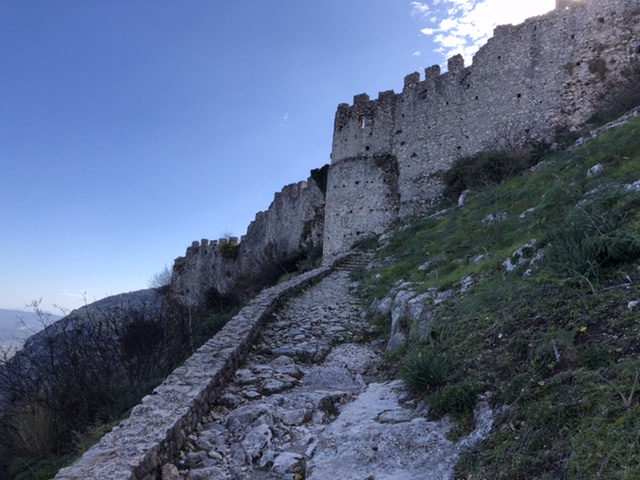
We were already reeling under the onslaught of history following our second visit to the island fortress of Monevasia. The day before we had wandered the narrow streets with the pups but had decided to return on the following day without them so we could climb further up to the old town. This proved a wise move because, not only was the path steep and winding, but the place was crawling with cats. In hot sunshine we climbed as far as the church of Agia Sophia which stands high on the rock overlooking the walls of the old fortress. 

Having gazed down at the roofs of the houses below, and across the sparkling deep blue Aegean, we decided to pop into a restaurant in the new town (a mere thousand years old) where the friendly owner served us with a wonderful mezze and lovely local wine. We took the remains of the carafe out onto the terrace where we were joined by five local cats

Cats seem to run Monevasia
We had originally planned to move on the following morning, but the weather was so nice, and the town so lovely, we decided to stay for a third night. After walking up to the local supermarket in the morning, we split up in the afternoon for a bit of me and her time. I wandered around the town, calling in at a small fruit and veg stall to load up with local oranges. We have become addicted to freshly squeezed juice and 20 oranges for less than €3 seemed too good to miss. Neri meanwhile disappeared for a couple of hours and took herself up to the highest point of the rock. She knows full well that I am not the greatest climbing fan and get vertigo on a thick carpet. 


The top of the rock 

The roofs of the new town

The church on the rock
We left fairly early (for us) on Friday morning and took the winding and sometimes steep road across the island towards Neapoli. In general Greek roads are in very good condition, but going through some of the hill villages, you can almost feel Florence’s sides being squeezed in as the road narrows between ancient houses. Our journey ended alongside yet another beach where we could take the spaniels for a run, and then relax to watch a spectacular sunset over the mountains to the west. 

We have had some lovely sunsets 

There can be few more beautiful places to be buried 

Spaniels seem to like beaches 


Tuesday, 21 January 2020

Monemvasia, the Gibraltar of the east


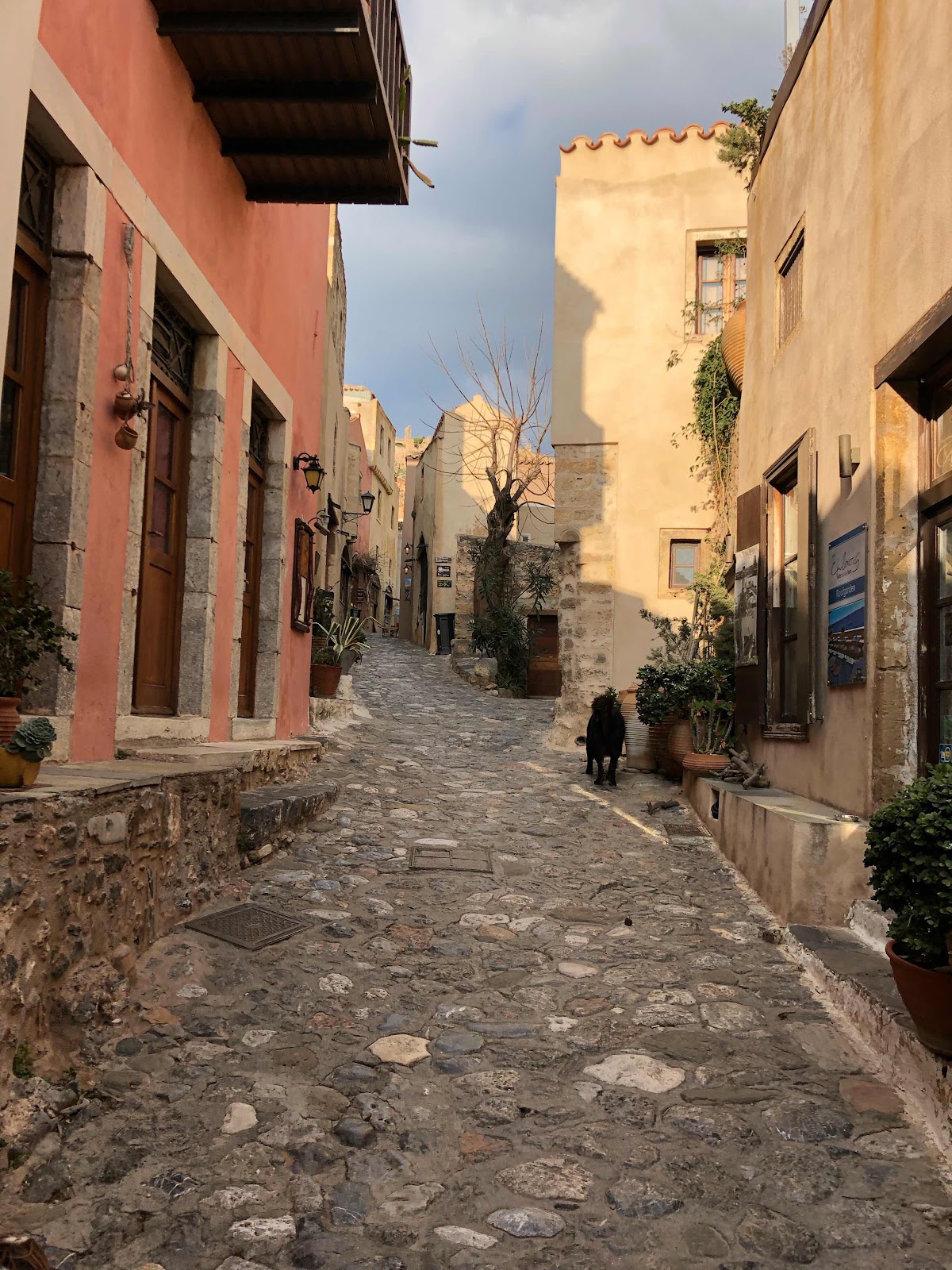
Our guide bounded over to us as we crossed the causeway to Monemvasia, giving us the usual enthusiastic Greek welcome. He led us along the road wedged between the sea and the sheer cliffs towering above, glancing back to make sure we were following. At last we reached a small arched gate in the wall ahead, big enough for a pack mule, but not for any modern vehicle much bigger than a quad bike. We ducked inside, turning right and then left to emerge back into daylight, and the sight of a narrow lane twisting ahead between soft yellow stone buildings. 

Our guide takes the lead
Once again our guide led us on, stopping only to confront a cat, and waiting patiently while we read interpretation boards along the way, pointing out churches, narrow steps up to other alleys, and good places to view the expanse of terracotta tiled roofs and the ruins of the great fortress above. The late afternoon sun glowed on the far wall of the fortified village, and it was time to turn back. As we re-emerged from the gate our guide wagged his tail, and went to greet a new arrival. We clearly hadn’t tipped enough
This should keep them out


We have barely scratched the surface of Monemvasia, the fortified island which is a sort of Greek equivalent of Mont St Michel. We’ll spend more time there tomorrow, after spending the night on the harbour wall at the nearby marina, apparently a place sanctioned by the police for Motorhome parking. Not that they’ll be too concerned at this time of year. There were only a handful of other visitors to be seen today, in summer the narrow alleys of Monemvasia will be thronging with tourists, and the shuttle bus will be busy ferrying people to the  citadel at the top of the rock. I suspect we may have to walk.
Churches and cannons
Monemvasia (meaning one way, ie there is only one way onto the island, and the same way off) is on the eastern side of the third, most easterly of the three larger peninsulas of the Peloponnese. We made our way here via a stopover on the other side of the neck, a remote track along a beach. It was an ideal place to pause on our way from Gythia, where we had spent four nights at Camping Mani Beach. It was enough to catch up with laundry and cleaning, and to take advantage of another long beach to walk the dogs. This time almost all the other vans on site were German, and although all were quick with a smile and a wave, language barriers prevented more interaction. 

Morning at Mani Beach

We made the most of the opportunity to unpack the chairs and table and sit in the sun, to hang washing up between the trees, and to peg the spaniels out in the sun to dry after they’d been playing in the surf. Our gas barbecue made a brief appearance, and we left a doormat outside. Almost everything that is defined as camping behaviour, and therefore not allowed in most of the places we stop for the night in Greece - and many other countries with the same rules. It isn’t something we particularly crave, but since we were paying €18 a night for the privilege, we took full advantage. 
The advantages of free camping
After leaving Gythia, we followed a spectacular road west to Skala, where we did some shopping in Lidl, and then, as olive trees gradually gave way to orange trees, to our overnight on the coast before Monemvasia. No chairs and tables, but direct access to the beach, a beautiful uninterrupted view of the sunset, and entertainment from passing sheep. They passed twice. A few seconds reflection and a closer look at their udders and we realised why. Just like a herd of cows at home, they had gone off to be milked.

Tonight’s view