Featured post

Follow our travels

If you want to see where we've been, you can use this interactive map. Click on the markers to see more about where we have spent the ni...

Saturday, 19 October 2019

Sunshine in the Valley of the Beautiful Women


Our decision to move south when the cold snap hit us in northern Poland has never looked better. We've had a settled period of sunny weather for the past week, and today saw us enjoying a warm breeze across Lake Tisza as we pootled over to a boardwalk in the centre of the reservoir on a small motorboat. We spent half an hour exploring the reeds and islands via pathways and hides, just managing to stop a hot Max from jumping into the water. After that we weren't in the mood to do much more than pop into Lidl for a few supplies, and roll into a campsite for the night - our first full facilities, official paid site since Norway. It was that or find a forest road and dig a hole, since we had found nowhere to empty the loo since the dry toilet in the lovely picnic spot on the Slovak border.  

The waterways of Lake Tisza


The Balrog meets the Tisa
We had spent a quiet night in Tokaj after our wine tasting there, and found a lovely walk along a bend in the river where the Bodrog meets the Tisa. We had followed the Bodrog down from Slovakia, but had immediately rechristened it the Balrog, which will mean nothing to anyone but Tolkien fans. From Tokaj we headed for Miskolc, where a laundrette called Bubbles proved to be one of the cleanest and most efficient yet, giving us very little time to explore, but keeping us on the right side of the traffic wardens. We stopped for lunch on the outskirts of town where we could nod to the castle while admiring a brand new equestrian venue with seating for several thousand people.

A quick glance at Miskolc centre


Another day, another castle...


Spaniels excluded while Florence gets a brush-up
From there it was up into the hills of the Bükk national park, via the small resort of Lillafüred, on a road with more twist and turns than two series of Killing Eve. Fortunately it was quiet, and the road was plenty wide enough to make it enjoyable to drive through the stunning autumn colours of a completely deciduous woodland. We stopped at a picnic area in the hills, turfed the dogs outside, and gave Florence's insides the clean they desperately needed. 


Presumably one of the beautiful women
The next morning we drove down to Eger, where an accommodating Mol service station allowed us to fill up with LPG, diesel and water, all in one go. A short hop took us to the Valley of the Beautiful Women, which one can only assume refers to the wine goggles acquired by people who frequent its many wine cellars. The name aside, it offered excellent free parking (out of season) and meant we could taste wine freely, knowing we were settled for the night. Having worked our way through a tasting menu, we decided the local dry white, Csillag, was very much to our liking. And Bikavér, which we had both encountered a very long time ago as Bull's Blood, had lightened and mellowed since its guest appearance at 1980s dinner tables, making it a good addition to the wine crate in the wardrobe.

Sadly, a single (generous) tasting was as much as we could manage at 3pm, and we decided to collect the pups from the van and explore the attractive town with its array of nineteenth century grand buildings. Stopping at numerous souvenir shops failed to elicit a single Hungarian flag sticker, and we all trudged back to the van as night began to fall. It seemed silly to start cooking when there were several good restaurants within a few hundred metres, so we splashed more than £20 on a good meal in one of the wine cellars. It was an enjoyable evening, even after embarrassing ourselves by asking one of the band for a table. Well they were all standing at the entrance dressed in folk costume, how were we to know they had just come out for a fag?

Wine tasting in the Valley of Beautiful Women


Eger town centre


This morning we woke up knowing we had only two tasks: watch England play rugby, and empty the toilet cassettes. We were out of the van by eight to take the pups on a "sniffing" walk through the town, and back for breakfast and rugby shortly after nine. Both were very satisfactory, and feeling on a high, I decided to have one last try for a flag sticker before leaving what might be our last encounter with souvenir shops. I took our spare Poland flag, and showed it to a woman at a nearby stall offering flags on fridge magnets, bunting, and short sticks, but with no stickers in evidence. She put on a thinking face, and disappeared into the back of her van, to reappear soon after with two ancient stickers of the map of Hungary, one of them in the correct colours. "That'll do," I beamed, and handed over my 300 forints. 

There still remained the issue of the toilet cassettes. Public toilets are few and far between here, and usually have attendants, who may or may not appreciate us emptying our cassette in their facilities. We haven't been brave enough to ask. The ubiquitous Portaloos and composting toilets of the Baltics and Poland have also dried up, and we have not even seen the "WC Bus" sign that indicates a service point for coaches with toilets. Environmentally, digging a hole in the woods is not a problem as we run chemical free, and we do carry a small shovel, but it isn't always practical, especially at a time of year when there are mushroom pickers around every corner. So that's why you find us in a campsite tonight. At least it means we will have empty cassettes, and be full of water as we head towards Romania.


Autumn in the Hungarian hills

Wednesday, 16 October 2019

Sunshine, wine and a screw loose


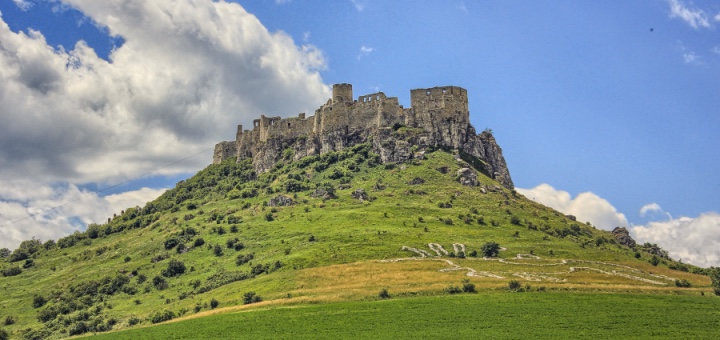
Since we entered Slovakia the weather has been nothing short of gorgeous and it remained so as we left the ski resort of Tatranská Lomnica and headed south. After negotiating some road works we were on our way to the city of Prešov where we had planned to do our weekly shop. We had paid €10 for an electronic vignette which allowed us to drive on Slovakian motorways so we passed the police ANPR camera van with a certain feeling of self righteousness. On the way we passed the spectacular ruins of Spiš Castle, perched on a hilltop, and described as one of the largest castle sites in central Europe
Spiš Castle towers over the landscape


On returning to the van from the supermarket, our feeling of deflation was reflected by one of the rear tyres which was obviously somewhat softer than it should have been. We discussed whether to pump it up and see how we got on but decided that, as we were in a city, we should get it sorted rather than wait until we were in the middle of the countryside. There is nowhere on Florence to carry a spare wheel so we would have had to rely on the inflation kit and I'm never too sure about them.

I have a screw loose
As it turned out we were able to find a small tyre place a couple of miles away on an industrial site. They were more than helpful, and had the wheel off, the problem diagnosed and the wheel back on all within an hour. It turned out we had picked up a broken screw from somewhere which had pierced the rubber. The young guy who fixed it was obviously new but he did speak English and one of the more experienced hands reminded him he was supposed to balance the wheel and put the valve cap back on. They only charged us €18

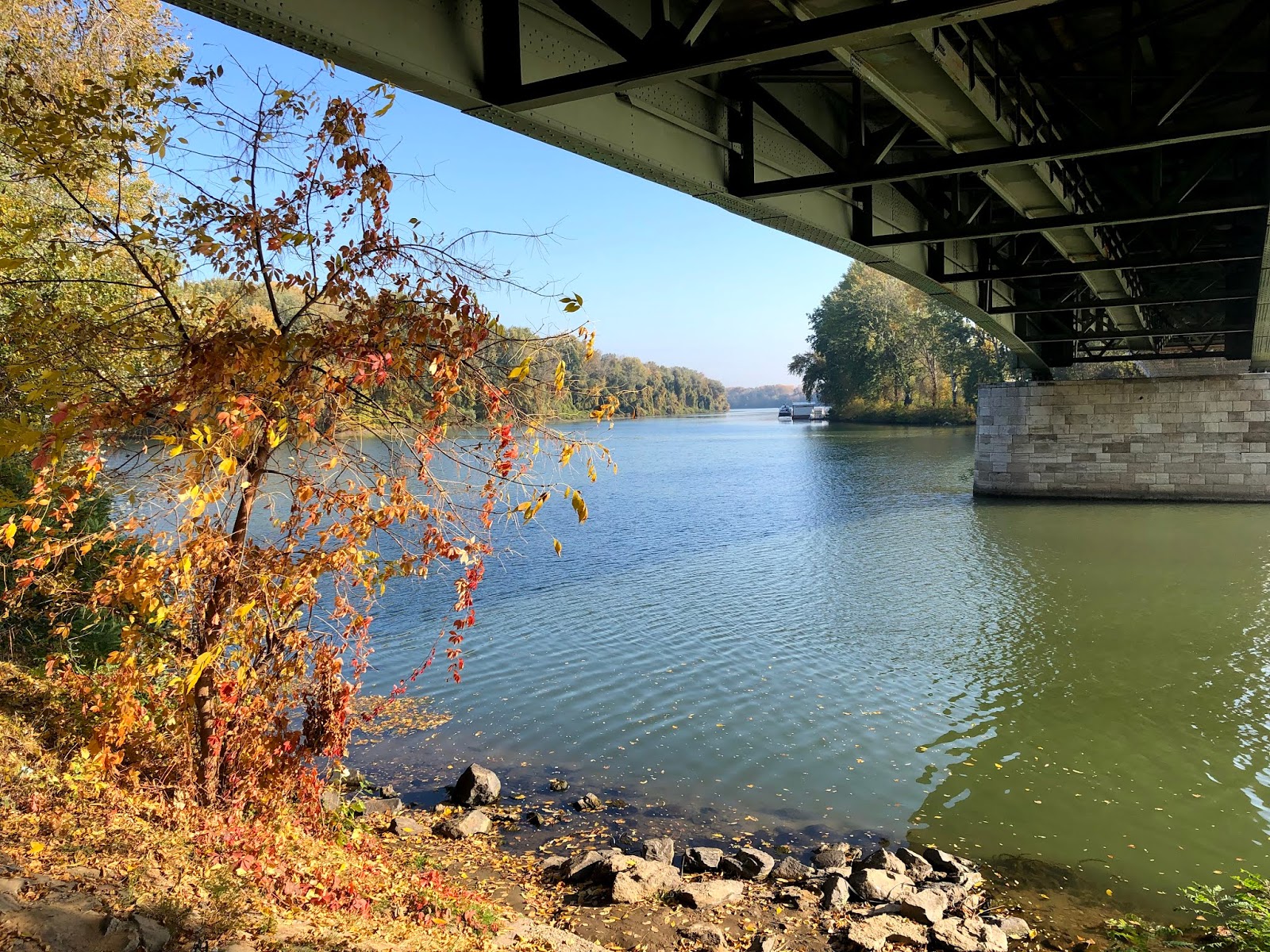
Later that afternoon we crossed the border into Hungary. Well, to be accurate, we crossed the border twice. The first time we discovered that the road on the other side that we were supposed to take, according to Google Maps, didn't exist, so we found ourselves travelling back up the motorway and into Slovakia again. Rather than turn round and go back over the border again, which might have raised a few eyebrows with the Hungarian security staff, we turned down a side road leading to a much smaller crossing. It turned out to be a good move as we were able to fill up with fresh water at a Shell garage on the way. We parked overnight at a picnic area just outside the little village of Hidasnémeti which had the advantage of having a compostable long-drop toilet, the first we had seen since leaving Finland. 

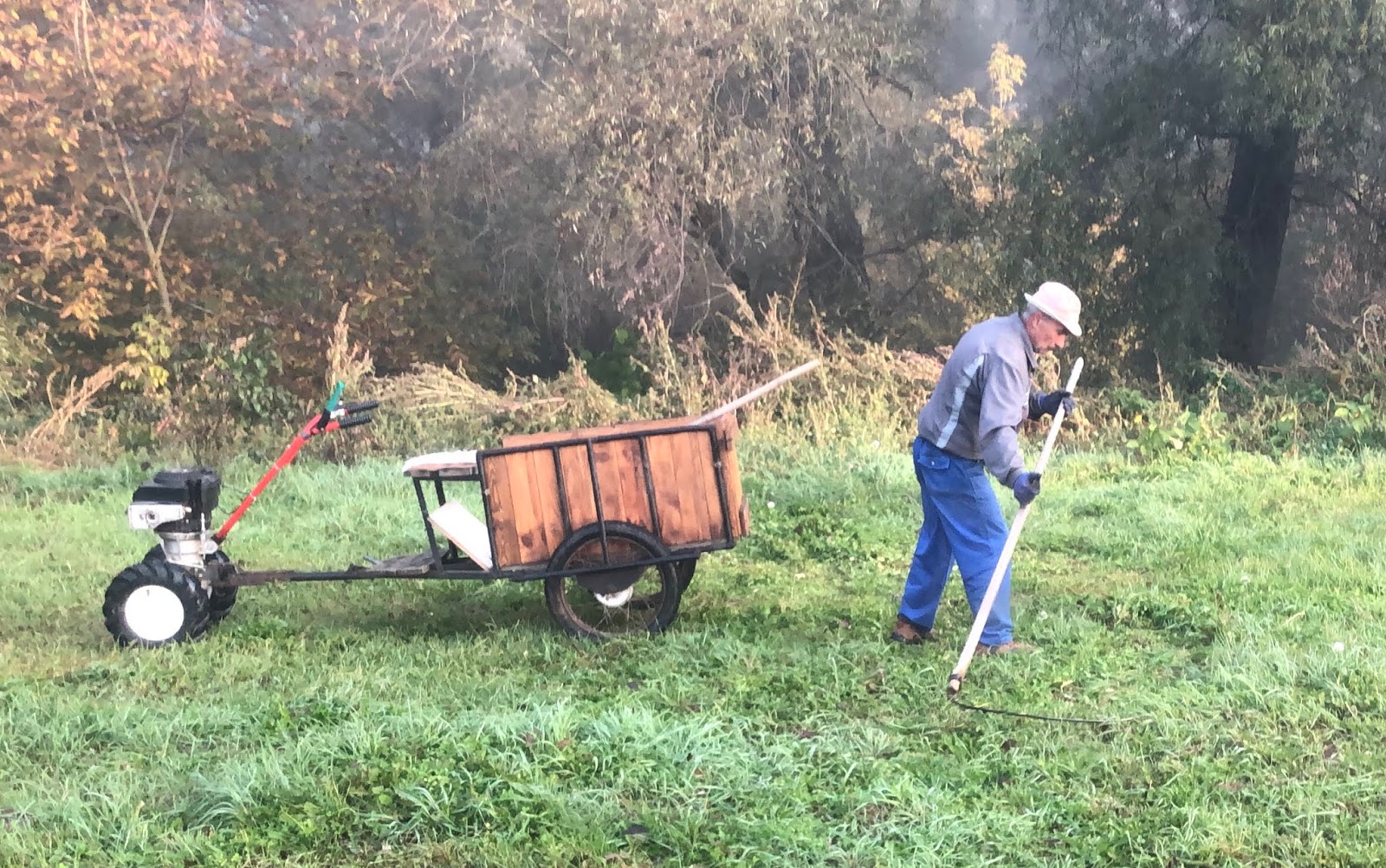
They still do things the old-fashioned way around here


St John kept the waters at bay
We slept well that night, no doubt because we were protected by St John of Nepomuk, whose statue stood close to where we were parked. The legend goes that he was the confessor for the Queen of the Bohemians and he was thrown into a river by her jealous husband for refusing to divulge the secrets of the Queen's confessions. Because of the manner of his death he is the patron saint for protection against floods which was very reassuring given there was a river next to the picnic site. However, a walk with the spaniels the next morning through the fields alongside said river with its steep banks and very slowly flowing water suggested that the Saint had not had his work cut out the night before. 

We set off across country along indifferent roads until the appearance of vineyards told us we had entered the Tokaj wine region, something confirmed by the large brown sign on the roadside. Tokaji wine is Hungary's pride and joy and rightly so, given that wine has been produced here since before the 12th century. A number of different styles are made but it is the sweet wines that command high prices among connoisseurs across the world. That they are expensive is due to the way they are made. Grapes are left to shrivel on the vines and be infected with botrytis, a fungal disease known as noble rot which concentrates the sweetness. Because individual grapes do not all achieve perfection at the same time, they are picked individually, rather than in bunches, and a vineyard may be picked over many times, a painstaking exercise
We have yet to visit an ugly vineyard


Obviously it would have been rude not to have called into a vineyard so we pitched up at the
These shrivelled grapes produce sweet nectar
Patriculus holding, described by Decanter magazine as the most beautiful vineyard in the region. We watched pickers moving among the vines before being called in for a tasting. Neri sportingly volunteered to continue driving, the alcohol limit in Hungary is 0%, so I tasted five wines and we came away with a dry Furmint, reminiscent of a Chablis, and a bottle of dessert wine which we will keep for Christmas. Some of the old sweet wines from this area sell for hundreds of pounds a bottle but our purchase was a little younger.

It was a short trip to the town of Tokaj where we had planned to spend the night, parked in a small side street under some trees. We had the opportunity to stroll through the pretty town and visit the local wine museum. We had also hoped to buy a Hungarian flag sticker to add to our collection on the back of the van, but although the local shops were stocked to the gunwales with fridge magnets, not a sticker was to be seen. A visit to a wine establishment allowed Neri to catch up in the tasting stakes and I was forced to buy a bottle of local Pinot Noir, a wine I had not expected to find in Hungary, that tasted much like a Burgundy. Sacrifices have to be made. 

Pictures of Tokaj

The central square


Sunshine on stone
The streets have an old-fashioned feel


The restored synagogue is a memorial to the Jews of the town
who died in the Holocaust


Monday, 14 October 2019

Sunshine in the High Tatras mountains


Nick and I are not beer drinkers as a rule, but we both enjoy the occasional cold one in the sun at lunchtime. In Scandinavia this was an unaffordable luxury, as it was likely to cost us half our daily budget. So we promised each other we'd treat ourselves when the opportunity arose. Throughout the Baltic States either the weather was against us, or we were moving on in the afternoon in areas with virtually zero blood alcohol limits for driving. When the cold weather arrived in Lithuania and Northern Poland we thought we had lost our chance. And then suddenly, the weather changed, we found ourselves free parking in a ski resort in the Slovakian Tatras, and we worked up a thirst climbing up a third of a mountain. So today we sat in glorious sunshine, in shorts and t-shirts, on a terrace, drinking beer. Gosh it tasted good.

No idea what we were drinking

900m ascent in a phone box
You may be wondering why we only climbed up a third of the mountain. Our overnight spot for last night and tonight is in the huge car park at Tatranská Lomnica, a popular resort in the High Tatras with multiple cable cars and chair lifts, and hiking trails in between. I persuaded Nick that such a playground in this weather was too good an opportunity to miss, and we should stay two nights and work out a combination of walking and cable cars that worked for us all and didn't break the bank. We planned to walk up to the second cable car, then take that up to the restaurant for lunch, and walk all the way back down. The third and final cable car has only a single gondola that travels almost 900m up to the tiny peak of Lomnicky štít (2634m) which has no other way of access. It doesn't allow dogs.

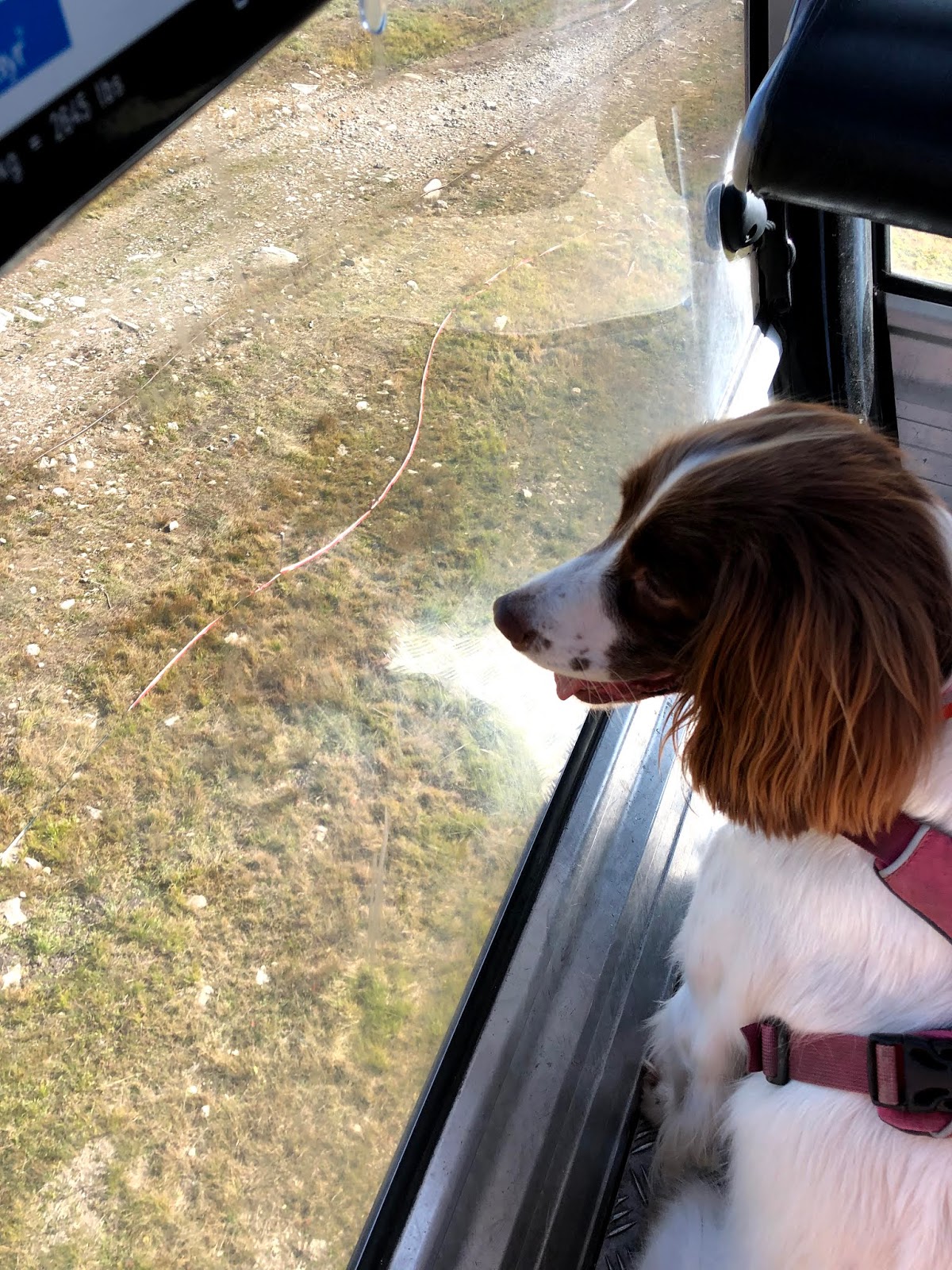
We set off at about 10am, having checked with the information desk that we could buy tickets on the mountain for the second cable car. The climb wasn't too arduous, and we were soon in the short queue for tickets. Only to be told that this halfway station didn't take cards. Fortunately I remembered I had an emergency €50 note stashed in my phone, and we were on our way. Elsa had a lovely time looking out at the view, but Max was less impressed. The ground fell away quickly, as we rose to 1751m, giving us a panorama of the plains below, and more of the Carpathian mountains in the distance. The Tatras is the highest range in the Carpathians, which curve through eastern Europe in a great question mark from Southern Poland through Romania and into Serbia. We'll be seeing more of them.


What Elsa saw

Right now it was the Tatras that had our full attention as we sat in the sun with our beers, gazing at the peaks behind and the panorama below. Nick generously offered to wait with the dogs if I wanted to go up to the very top, he knows how I love to get to the top of mountains, but sadly the tickets were sold out for the day. Instead we relaxed in the sun, then enjoyed a locally inspired lunch of goulash and pork knuckle to sustain us for the return leg. It took a couple of hours to climb back down the mountain, with both spaniels on their best heel-walking behaviour - essential if one is to avoid a rather more precipitous descent than intended. We shall all sleep well tonight.

The path back down


Dobczyce castle. Because it was there
The nights are definitely drawing in, and these last few days of relatively low mileage cannot continue for long if we are to get south before any risk of bad weather. But the area south of Kraków has been delightful, and worth a bit of time. After leaving Wieliczka, with its impressive salt mine, we headed cross country to the pretty village of Dobczyce, for no other reason than it had a lake (reservoir) and a castle, and somewhere to park Florence and walk the pups before lunch. In the afternoon we rejoined the main road south, where I got increasingly excited at the sight of the lumpy bits in the distance. Our destination that night was Zakopane, the most famous ski resort in the Polish Tatras. 

We parked up for the night in a small car park after a bit of good natured haggling with the attendant. Park4Night reviews had warned us of a tendency to hide the rates and overcharge foreign tourists, but he was remarkably phlegmatic when I insisted: "My friend said 20 zloty." And that was what we paid, having carefully husbanded our last remaining cash in preparation. We left the spaniels in the van, and set off to explore Zakopane. We were expecting a small mountain resort. What we found was basically the Polish version of Banff (the Canadian one, not the Scottish one) with the best part of a mile of posh shops and restaurants, every outdoor brand you have ever seen, magnificent wooden villas, and crowds the like of which we hadn't seen since the last encounter with a cruise ship. It all felt a little surreal, but rather impressive too. 
A busy night in Zakopane


The outskirts of Zakopane
The next morning we headed in the opposite direction to walk the pups, towards the National Park. Soon it was like walking to a game or a concert, with people appearing from all directions, all walking in the same general direction, and all dressed alike - in hiking shoes and technical gear, carrying rucksacks and walking poles. (You can make that joke, I couldn't possibly.) We only went as far as the National Park centre, a good walk with beautiful scenery right on the edge of the town, and then turned back. 

We had decided to cross into Slovakia via the border village of Lysa Polana, and to take the mountain road from Zakopane to get there. Having initially dismissed the road as being too curvy, I had used Google Maps Streetview to establish that there was a white line and a good surface, it was only 18km, and we had driven much worse. The road itself was indeed fine. But it was a Sunday in the middle of period of warm and dry weather in October. The whole of southern Poland was trying to get to trail heads in the Tatras, and those that couldn't get into car parks were parking on the road. I managed to squeeze Florence through the gaps, but there was nowhere to pull over to let traffic past, so I was treated to a couple of loud blasts of the horn for daring to be on the road holding people up. I breathed a sigh of relief as I saw the more major road ahead, and was about to follow Nick's direction to turn right at the roundabout, when I saw that the turning had a 3m height limit. I turned left instead, and pulled into the first space off the road. 

Florence is 2.9m high. But she has a 15cm rigid aerial on top. We have survived a 3.2m height limit with relative comfort. But what was this obstruction, and could it rip her aerial off? Having established that a) it was a relatively main road, b) the weight limit was 7.5 tonnes and c) the alternative meant a long diversion, we decided to risk it. There were a lot more cars parked in the road, the massive car parks for hikers at Lysa Polana were completely full and traffic was backing up, but we made it through the border, and we still haven't the faintest idea what the height limit was about. There was no bridge, didn't appear to be low hanging branches, no cliff walls looming over us... we shall probably never know, but suddenly we were in Slovakia.

Not a bad place to stop for lunch


It was almost lunchtime, and so we pulled over at the first piece of rough ground with no cars, and took a deep breath. To our surprise, we were at a modest trailhead. Nothing too popular, but there were a few people returning from a hike, and we had managed to get one of only about six spaces. Given that we were planning to spend the night in a popular hiking resort, we felt it made sense to stay put until spaces were likely to become available later. After lunch we watched the Scotland-Japan Rugby World Cup match, and then spent an hour or so exploring the path we had parked beside. At about 4pm we headed on to Tatranská Lomnica, and found a space fairly easily in the top tier, which is where campers are supposed to park. Luckily it was Sunday evening, and most people have to go back to work. Oh well. 


Saturday, 12 October 2019

The barriers of language and a great deal of rock, all taken with a large pinch of salt


The Foreign Service Institute, which trains US diplomats, has produced a list of the world's languages ranked in order of difficulty for English speakers to learn. Polish, along with the languages of the three Baltic States is among the hardest only being beaten by Arabic, Korean, Japanese and Mandarin Chinese. The use of diacritics means the Polish alphabet has 32 letters which complicates things. Road signs are a constant source of wonder.

It really isn't easy
This was all brought home to me in the village of Tarczyn where we had overnighted. A quick stroll to the local pharmacy the following morning brought us into contact with an old boy who was fascinated by the spaniels and began asking questions in Polish. Had this been France, Spain, Italy or a number of other countries, I might have picked up the odd word and understood the gist of what he was saying. But this time I was completely stumped. It was only after a great deal of pantomiming that I realised he was asking me how much a Springer Spaniel puppy would cost. Bizarrely he wanted to know in US dollars. Eventually I wrote the figure on the notepad app of my phone to show him before we shook hands and parted. 


Heading south on the S7 motorway, it will be nice when it's finished, we arrived in the city of Kielce, dropping  anchor in a car park next to a former limestone quarry which has been turned into a geological park. A walkway has been constructed and we wandered round with the Spaniels admiring the various textures and colours in the towering rock face. We were also taken by the amphitheatre with its retractable roof, built into the side of a hill and used for numerous artistic performances and festivals. 
A row of busts......


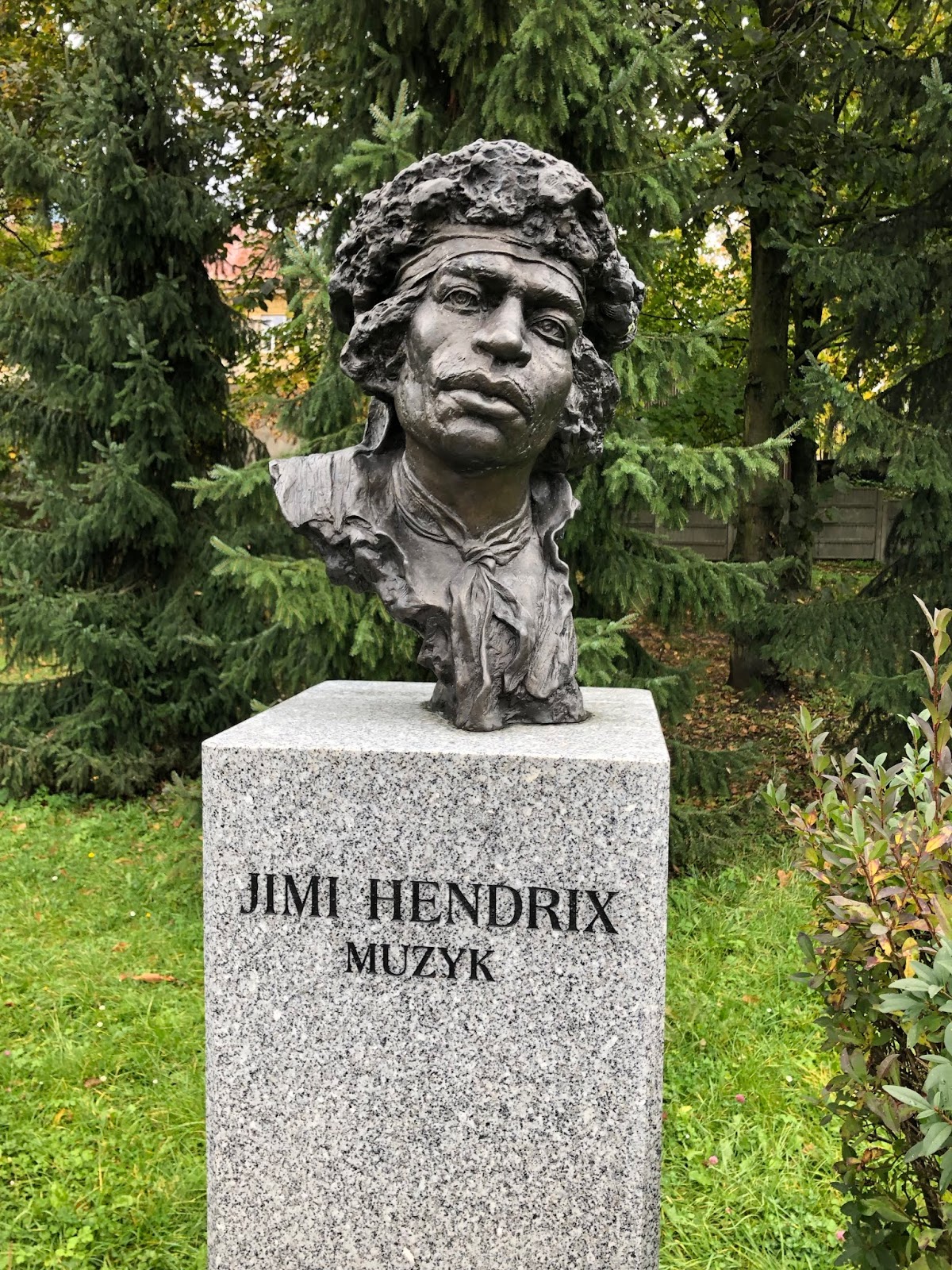
The next morning we plotted a course through the park to the old part of the city. On the way we were intrigued by an eclectic collection of bronze busts alongside the path, probably 30 or 40 in all. It seemed to be a celebration of the performing arts with poets, composers, musicians and painters among the busts created by a variety of sculptors. Among notable Polish figures we also spotted Salvador Dali. Marc Chagall, Leonard Bernstein, Marilyn Monroe, John Lennon and Jimi Hendrix. 
....one of which is of a great guitarist


The high point of the walk was the summer residence of the Bishops of Kraków, which towered over the city, complete with an ornate formal garden in the 17th century Italian style. The building itself is a mixture of Polish and Italian architecture, a marriage that seems to work well. In Kielce, as elsewhere in Poland, it is impossible to escape the brutalities the country has suffered in the past. The city was the centre of Polish resistance to the German occupation and the hills around it were used by partisans to harass the invaders. Consequently many of the city's inhabitants lost their lives. Like other Polish cities the local Jews were herded into  ghetto and here were joined by Jews transported from other parts of the country. In 1942 the ghetto was liquidated and the survivors sent off to be gassed in Treblinka.

Katyn is seared deeply into Polish history
The country lost a generation of academics and military officers
Another atrocity was commemorated at a memorial, not far from where we were parked. In April and May 1940, some 22,000 Polish military officers and academics were brutally murdered by the Soviet secret police, the NKVD, in the forest of Katyn in Russia. For the next 50 years the USSR denied it had anything to do with it, finally acknowledging its responsibility in 1990 and blaming it all on Stalin. The memorial lists the names of dozens of inhabitants of Kielce who were among the dead, many of them professors and academics.

With a pretty good road ahead of us we decide to push on to Kraków where we arrived late in the afternoon. As with Warsaw we had managed to find a small car park, complete with 24 hour security, within a short distance of the old town. We took the Spaniels down to the River Vistula, the very same waterway that had provided us with our first dog walk in the Polish capital. On our way back to the van we passed the New Jewish Cemetery, an 11 acre burial ground begun in 1809 and containing some 10,000 tombs. It was desecrated by the Germans during the occupation but has been lovingly restored since the end of the war. Two other Jewish cemeteries, created in the 1920s and 30s were completely destroyed when they were utilised as the site for the notorious Kraków-Plasźow concentration camp.
The New Jewish Cemetery reminded me of Highgate


The one faint ray of light in the city in this era of darkness was an industrialist named Oscar
It is difficult to escape Schindler references in Kraków
Schindler. It is impossible to escape Schindler in Kraków. On our walk with the pups this morning along the Planty, the strip of parkland that follows the line of the former defences of the old city, we discovered the name of  the Australian writer Thomas Keneally on a park bench, the man whose fictionalised novel of Schindler's life became the basis for Stephen Spielberg's film, Schindler's List. Schindler's enamel factory, which still stands in Kraców, employed over a thousand Jews whom he protected from deportation and certain death. 


Kraków's Cloth Hall is stunning
Kraków is much more of a tourist magnet than Warsaw. The medieval market place with its ornate cloth hall in the centre is one of the largest in Europe and the streets of the old town are well worth a stroll. Rattling trams vie with white carriages, drawn by ornately decorated horses ferrying tourists around the streets. We were recommended to try an obwarzanka, a jumbo pretzel-type product, being sold at a number of stalls around the city but, I regret to say, we found it rather dry. But, all in all we were very taken with the place and wished we had more time to explore.
A civilised way of seeing the city


Salt statues are a feature of the mine
Our final stop of the day was the small town of Wieliczka which boasts one of the world's oldest salt mines where production started in the 13th century. We left the spaniels in the van and spent a couple of hours walking though a fraction of the 178 miles of tunnels created out of solid rock salt. On the way we passed underground lakes, and statues carved out of salt. One of these was of St Adjutor who is, apparently, the patron saint of drowned people. Appropriately he was standing in a lake. My first thought was that if saints were all they are cracked up to be, he would have saved them from drowning in the first place. 

The piece de la resistance was the stunning St Kinga's chapel, hundreds of feet down in the mine and carved out of the salt. Even in mid-October the car park was packed with coaches from Poland and beyond and tour groups busily negotiating the tourist tat stalls and descending the 200 feet into the ground. 

St Kinga's chapel, 100 metres underground, can be hired for weddings
Tonight we have broken with tradition and are in a paid camping area, albeit our only companion is a German motorhome a few yards away. Tomorrow we head south for what will probably be our last night in Poland before we cross the border into Slovakia. Poland has made quite an impression on us and we have decided we must put it on our list for a future visit. Hopefully we may be able to say hello and goodbye in Polish by then. 

Images of Kraków

St Mary's Tower.  
A short break in the Market Square


Many of Kraków's buildings survived the war
The Planty is a great dog walk