Featured post

Follow our travels

If you want to see where we've been, you can use this interactive map. Click on the markers to see more about where we have spent the ni...

Tuesday, 8 October 2019

Having a wonderful time in Warsaw


For much of my life people have misheard when I said where was I born, and thought it was in Poland. Actually it was Walsall, but you can see how the misapprehension arises. Now, finally, I have been able to see the city at the source of the confusion, and it's been a revelation. Our Lonely Planet guide book provides a pull-out city map of Krakow, but fails to offer one for Warsaw, as if the capital is the poor relation in tourism terms. Well we haven't seen Krakow yet, but Warsaw has been spectacular.

It always helps when the weather plays ball, and after spending time in Tallinn, Riga and Vilnius in the rain, and conversely, having to travel around Oslo at 7am to avoid the intense heat, a cold but sparklingly clear autumn day was just perfect for Warsaw. We arrived on Sunday afternoon, having decided to skip more of north-east Poland, as October had very definitely heralded the end of the tourist season, and cold nights are pushing us south. A fabulous gated and guarded car park on the edge of the Old Town meant we had freedom to wander without worrying, and could happily plan for a 48 hour stay at the cost of just £8 a night.

We decided to keep the Old Town for the morning, and take the spaniels to explore the parks and the promenade along the shore of the Vistula. We found a lovely expanse of grass, fabulous fountains which glow in a laser display at night, and a lovely river front quay, facing an eastern shore with beaches and trees. Glimpses of the roofs of Old Town promised much more to come. We had a quiet night, and woke well rested for a long day ahead.


An evening walk by the Vistula


The remains of the gibbet enclosed
Our first priority is always a walk for the pups, and by 9am we were striking out to the north, where aerial views show the unmistakable zig-zag of an old citadel. We walked around the defensive wall of a fortress built by the Russian Tsars in the 1830s to intimidate the Poles after an insurrection. Now it remains a military base, but is surrounded by parkland and there were plenty of dog walkers on the more open, western side. The eastern side, near the river, is the site of the only remaining gate, the Brama Stracen fragment, where the remains of a gibbet, encased in a monument, mark the spot where political prisoners were executed after an uprising against the Russians in 1863.  Warsaw uprisings would become a theme throughout the day.


With the dogs well exercised, and with Florence in a safe parking spot, we decided to leave them to sleep off breakfast while we explored the city. We knew, before we set eyes on it, that 85% of Warsaw had been destroyed by the Nazis in a violent reprisal for the Warsaw uprising, a revolt against German military occupation in 1944. I'll say that again. 85% of the city was destroyed. And yet they decided, rather than move the capital after the war, that they would rebuild it. And they have rebuilt it, brick by brick, to such an incredible extent that the Old Town now has UNESCO World Heritage status.  They used old plans, photographs and prints, paintings by masters like Canaletto, and whatever local knowledge was available, to recreate Warsaw. But it doesn't feel like a recreation. There are parts of the Royal Castle that look too new, red brick is a poor pretender, but the vast majority of the Old Town, and the Royal Way, look at least 200 years old. No doubt nearly seventy years of weathering have helped, and picking a particular date to which one can roll back the clock ensures a uniformity of design, but the market square in the Old Town is one of the most beautiful we have seen.  We were blown away.


The Old Town Market Square in 1944


The Old Town Market Square today
A "present" from the USSR
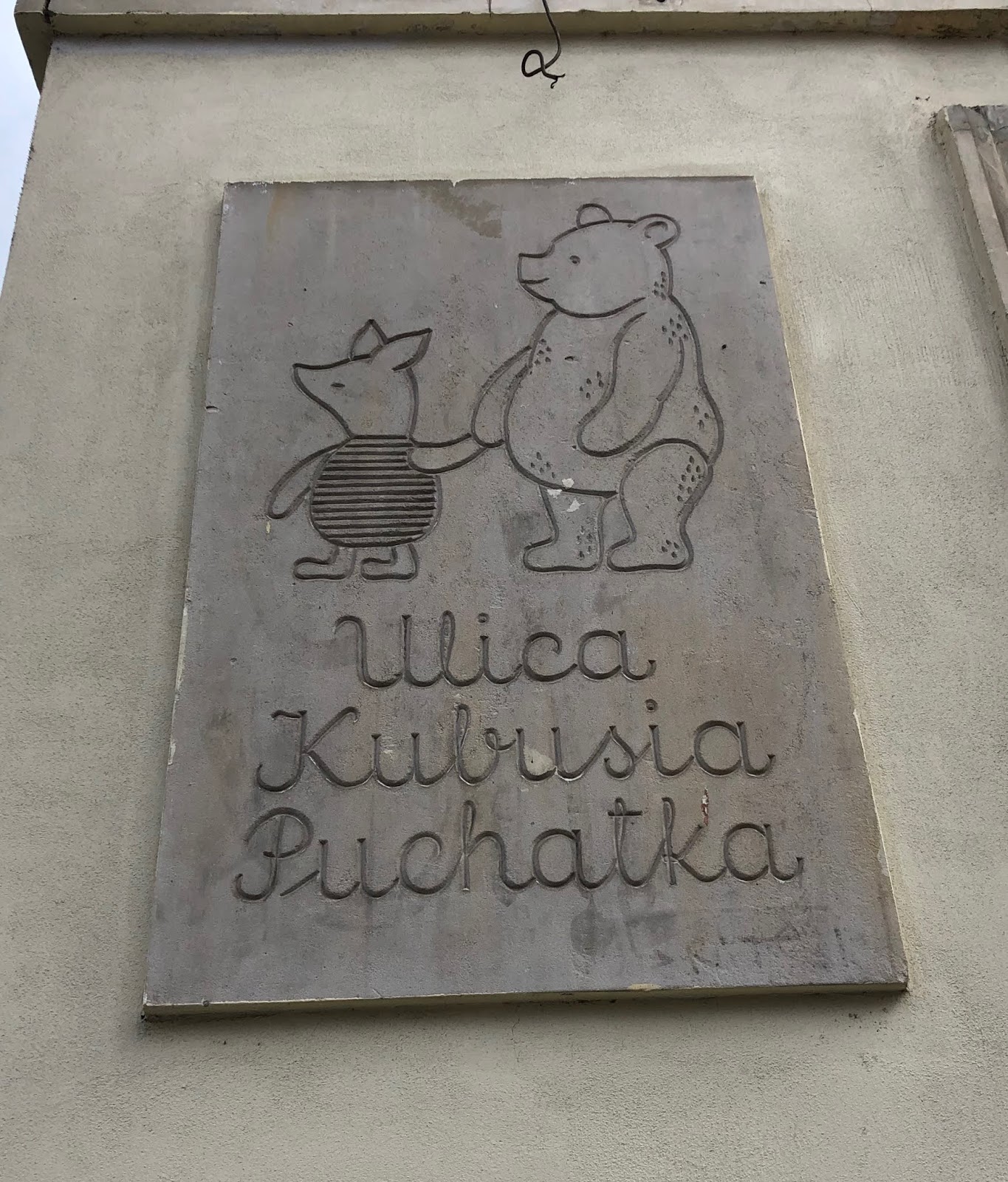
Walking south from the Old Town along the Royal Way, we passed several fabulous buildings, churches, parts of the university, and statues. We popped into the Church of the Holy Cross to see the urn containing Chopin's heart. (We'd visited the rest of him in Pere Lachaise cemetery in Paris twenty years ago.) And we waved at the statue of Nicolas Copernicus. Then we decided we had time to walk to the British Shop, providing we took the tram back. We set out into the financial district, and suddenly we were faced with the most extraordinary sight, a cross between Big Ben and Battersea Power station, with frilly bits. It was the Palace of Culture and Science, a "gift" from the Soviet Union in the 1950s to house exhibitions, theatres, cinemas and any other cultural activities required. It divides people to this day, but looks likely to remain, if for no other reason that it provides tourists with an exciting view of the city. Unfortunately, we didn't have time to scale the 30 floors to the observation deck, as we had spaniels waiting. Instead we pressed on to the British shop, purchased our exorbitant jar of Marmite, and jumped on the tram, pausing only to wonder at the site of Winnie the Pooh Street (yes, really) and a shop window dedicated to Diana, Princess of Wales.


Winnie-the-Pooh Street
The British Shop: Marmite acquired


The tram ride gave us another view of the city, including more Soviet style architecture, and of course the pups were absolutely fine when we got back - warm and sleepy. But our planned lunch out had been ditched in favour of a prompt return, so we decided to enjoy Marmite on toast in the van, and eat out in the evening instead. After a good rest it was time to set off for another walk, this time with pups in tow. We headed west in search of some spectacular, thought-provoking and saddening reminders of history. Along our route were  monuments commemorating Poles deported under Soviet occupation, Jews sent to Treblinka and murdered, German Chancellor Willy Brandt's 1970 visit to Warsaw when he fell to his knees in a gesture of contrition for German's crimes against Polish Jews, the Jewish people who died in the 1943 ghetto uprising agains the Germans, the wall of the ghetto, the people who took part in the 1944 Warsaw uprising against Germany... The list goes on, and soon my head felt too full for any more. Luckily we saw a restaurant serving mulled wine, and we sat outside with the pups and took solace in the heady aroma of cinnamon and cloves as we digested what we had seen. 


A roll-call of Jewish first names is the only other inscription
It was a short walk back through the New Town (only dating to the 1400s) to our car park to feed the pups, make ourselves look a little more presentable, and retrace our steps to a delightful restaurant with "fine dining" food and service at High Street prices. Nick had the Bigos, which he'd been recommended to try (cabbage soup reheated multiple times with whatever meat was handy) and I had fish pierogis to start. Then he had beef tenderloin, and I had Zander (more fish) with saffron broth. It was all beautifully cooked, and our waiter, Eugene, was delightful in his eagerness to emulate the great French Maitres'D he'd spend a short time working with in Paris.


View on a morning run
After such a lovely day, it wasn't easy to stir this morning, but the day dawned cold and clear, and I set off for a run along the Vistula. Later we took the pups back to the park by the fountains for a game of ball, tipped our hats to the statue of Marie Curie, and then walked back through the Old Town. We couldn't resist one more chance to see the fabulous market square at its heart. We had parked less than a mile from the biggest shopping centre in Poland - a Westfield of course - and I was in desperate need of new walking shoes, so I then jumped on the tram to make some necessary purchases, before we said goodbye to our lovely car park guard. We drove to the outskirts of Warsaw, where we could find a Speed Queen Laundry and an Auchan hypermarket next to a Circle K garage - all we needed for clean clothes, a full fridge and a replenished LPG tank. By the time all that was accomplished it was getting late and the weather had changed for the worse, and so we are now parked up about 40 minutes out of Warsaw on the site of a farmers' market, ready to press on towards Krakow tomorrow.


Back to the Market Square


The Church of the Visitandines, Canaletto
The Church of the Visitandines,today

See Chopin "Live". You'd have a job
Memorial to those deported under the Soviets

To the political prisoners of Stalinism

Memorial to the Ghetto uprising in 1943

Part of the Warsaw Rising monument

The Ghetto wall


Saturday, 5 October 2019

New country, new currency and some very dodgy driving


It's three months and 6,759 miles since we left home in Darwen to set off on this 12 month European adventure and tonight finds us preparing for our second night in Poland, having crossed the border from Lithuania yesterday afternoon. Autumn is short in this part of the world and the chill winds are beginning to blow. We expect it to fall to -3℃ tonight so the heater may well be left ticking over to keep us all snug and cosy.

We nearly took her home but the pups objected
Yesterday morning we enjoyed a lovely forest walk with the spaniels on the edge of the spa town of Brištonas. Elsa was able to have a run off the lead but Max had to be kept secure due to the closeness of the river and its inviting ducks. We then headed South West on the A5, stopping at a Circle K service station in the town of Marijampolë to top up with fresh water. The countryside hereabouts is pretty flat and featureless, bisected by the E67 road which seems to be the main route for trucks heading up and down between northern and southern Europe.

Our lunch stop was a few hundred yards off the main road where we parked outside a church surrounded by just four houses. Congregations must be small here and the large cemetery looks set to cater for deaths for a considerable period into the future  Hardly had we stopped when the pups started going berserk and we discovered we had an audience in the shape of a tiny kitten that was mewing outside. It seemed totally unmoved by Elsa's hysterical barking and sat placidly outside the van, happy to allow Neri to go out and pick it up. We were only able to leave after a good search underneath Florence, just to make sure it was not sheltering from the rain squalls that were now rattling our windows.
Another forest walk


We crossed into Poland late in the afternoon noting that, while there seemed to be all the infrastructure of what had been a closed border, the buildings were completely deserted. The only sign that this was a frontier were a couple of vehicles with armed customs officers leaning against them. They barely glanced at us as we crept through, being careful to comply with the 20 kph speed limit. We seemed to be the only ones who did as cars and 40 tonne trucks shot past us. 

We rapidly came to the conclusion that driving standards in Poland were the worst we had come across so far. Speed limits and Give Way signs are treated by locals as advisory only and having someone in front of you is seen as an immediate challenge to creep as close as possible to the rear of the offending vehicle before swerving out to overtake, often in the face of oncoming traffic. Bad enough when it's a car but a little intimidating when it's a massive truck. However we were amused that  Polish road signs warning of potential dangers had suitably added graphics to ram the point
Beware of pedestrians
home. 


As we approached the small city of Suwalki we saw a large off-licence and felt it would have been rude not to stop and have a look. We discovered that wine is very cheap in Poland, even cheaper than Lithuania. Indeed, there were several Lithuanian registered cars in the car park. Having topped up with the essential red and white, we went to look for a cashpoint. Poland isn't in the Euro and having seen their very nice notes, I hope they never join. A quick visit to a supermarket for some milk and then we drove down to the car park of a local museum at the wonderfully named village of Stary Folwark where we had planned to stay the night. We had been advised to ask permission first but, on arrival, we discovered the museum closed at 3pm so we parked up.


The cash is very picturesque
Crossing into Poland meant our clocks went back an hour so we woke early and were gone well before the museum opened at 10 am. Just up the road was a trail through part of the Wigry National Park. Technically you are supposed to buy a ticket to enter the park but the office, like most of the tourist attractions in Poland, seems to close down for the winter so we enjoyed a free walk that took us through a lovely bit of forest which included a lake with a beaver lodge. We also stopped to admire the tall clay and wood bee hotels which were situated along the path. There were plenty of information boards in Polish and English which gave us details of the local flora and fauna. 
Bee hotels

We headed south to the resort town of Augustow where we parked up by the canal for lunch. The waterway is an amazing piece of engineering that runs for more than 100 km from close to the village of Wizna in N E Poland to Belarus. Described by experts as a 'technological marvel' it utilises natural lakes and rivers to provide a waterway that was built to bypass huge customs duties imposed by Prussia on Polish and Lithuanian goods passing through its territory. Originally used by commercial shipping, mainly carrying forest products, it fell victim to the coming of the railways, in the same manner as canals in England & Wales. Today it is one of Poland's official historical monuments.
A plaque celebrating the Augustow canal


Late afternoon saw us arrive at the remains of an ancient hill fort near the village of Korycin. The old wooden defences have been completely reconstructed and a 1949 windmill has been added to the site after being moved from elsewhere. There is plenty of information about the original Bronze Age settlement, that was still being used as a watch tower in the 11th century AD. All in all it is a very impressive site which looms behind us as I type this. They have also been kind enough to allocate two spaces for motorhomes although, at this time of year, it is highly unlikely we will be jostling for space with anyone else.

Our impression of Poland in the short time we have been here has been a very positive one. People are extremely friendly, a family stopped to admire the spaniels and practice their English this morning. Even where people speak no English they go the extra mile like the checkout operator in a supermarket who helped me with the Polish instructions on the card machine. 
Recreated defensive works on the hill fort


Some things have changed from the motorhome point of view. Having wild camped in forests throughout Scandinavia and the Baltic countries, we are now in a country where wild camping in national parks is not allowed and, in October, most campsites are shut down for the winter. We will be relying more than ever on our app, Park4Nights, to suggest places where we can spend the night. One of those places is a secure car park in Warsaw. We are heading for the Polish capital tomorrow, no doubt dodging the mad truck drivers on the way. 


This is looking down on us tonight
Florence on CCTV at the hill fort


Thursday, 3 October 2019

A story of freedom in the centre of Europe


It’s our last night in Lithuania, tomorrow we cross into Poland after a busy couple of days in Vilnius and around, including a rare meal out,  continuing wet weather, and a cemetery with more stories than the British Library. All this culminated this afternoon with a visit to Trakai, Estonia's must-see destination, pulling in a million tourists a year.

We were incredibly lucky with the weather in Norway, with four weeks of perfect blue skies, several days too hot for the occupants of Florence, and almost no rain for the duration. Things changed when we got to Estonia, but we have still had lots of fine autumn days. Autumn does arrive early in the Baltics, the tree colour in Lithuania has been spectacular, but we have been fairly lucky, except when we've approached a capital city. It rained in Tallinn. It rained in Riga. And, sure enough, it rained again as we parked up in Vilnius.

The Centre of Europe. Really.
We had started the day in the Geographical Centre of Europe. A moniker several places lay claim to, but this one is endorsed by the Guinness Book of Records, so it must be true, right? Just like the disputes over Nordkapp, it depends on whether you are counting islands, which ones you count, and where you draw the edge to the east. Anyway, it was good enough to provide a parking space, albeit in the middle of a golf course, so we had settled down for the night with only the occasional buggy bumbling past until twilight. In the morning we visited the marker stones, and then took the spaniels for an amble over a nearby hill fort, around a couple of villages, and back past the sixth tee. All this in full waterproofs, with a persistent drizzle, and long wet grass which drenched even the most technical of waterproof shoes. 

From here it was straight to Vilnius, where a large Rimi hypermarket on the outskirts allowed us to do our weekly shop and top up the dogfood. By lunchtime we were tucked up in a secure paid car park just across the river from Vilnius' castle and the old town, with the rest of the day to explore. The view from the top of the nearby hill was spectacular, even in the gloom, and we enjoyed our meander around the vast cathedral square, where a single tile  - the miracle square - marks the end of the Baltic Way, a human chain which stretched from Tallinn to Vilnius on 23rd August 1989. It involved two million people, spanned 675km, and marked the 50th anniversary of the Molotov-Ribbentrop pact between the Soviet Union and Nazi Germany, which led to the occupation of the Baltic States in 1940. It was a demonstration of the desire for self-determination, and seven months later Lithuania become the first of the Soviet republics to declare independence. 
Rooftops of Vilnius

Max finds the miracle square
More icing sugar churches
We'll return to the story later, but first we continued from Cathedral Square into the Old Town, which is so dense with churches that they almost ran out of saints after which to name them. A typically mean-spirited act by the Soviets saw one of them turned into a museum of Atheism, as they tried to wipe out faith. Now, they are being energetically restored, but many of them are in a Baroque style that did little for us, and there was no opportunity to enter any of them as we had the spaniels with us. The city lacked the old guild buildings and wooden houses that had so appealed to us in Tallin, and the Art Nouveau splendours of Riga. The classical style of the university quarter was elegant, and that was the area which we would have explored more, had we returned without the pups. We could not help but be affected by walking through the old Jewish Ghetto, now the linen quarter. Lithuania had a thriving Jewish population before WWII, the Jews having been invited to settle in 1400 by the then king. A large part of the population lived in Vilnius, a global centre of Yiddish learning, but they were almost all murdered by the Nazis by 1944. Of the small number that survived, many of their families moved to Israel during the lifting of travel restrictions (Perestroika) in the 1980s. 

We returned to the van in solemn mood, but it was time for a glass of wine, and a rare opportunity to dress up a bit. Nick had been paid for some family history research, and we were parked in a city where we could safely walk to a restaurant and leave the spaniels in the van to sleep. We found a place called Grey, just ten minutes walk away, and had lovely meal of Lithuanian pancakes to start, followed by pork shank (him) and trout (her). A shared dessert of crumbly apple pastry and froth filled the last remaining crevices. The service was excellent and the ambiance modern and comfortable. The only slightly surreal moment came when looking up to see Peter Capaldi in a music video on a screen over the bar. Apparently singer-songwriter Lewis Capaldi is his cousin. 


A great place for a game of ball
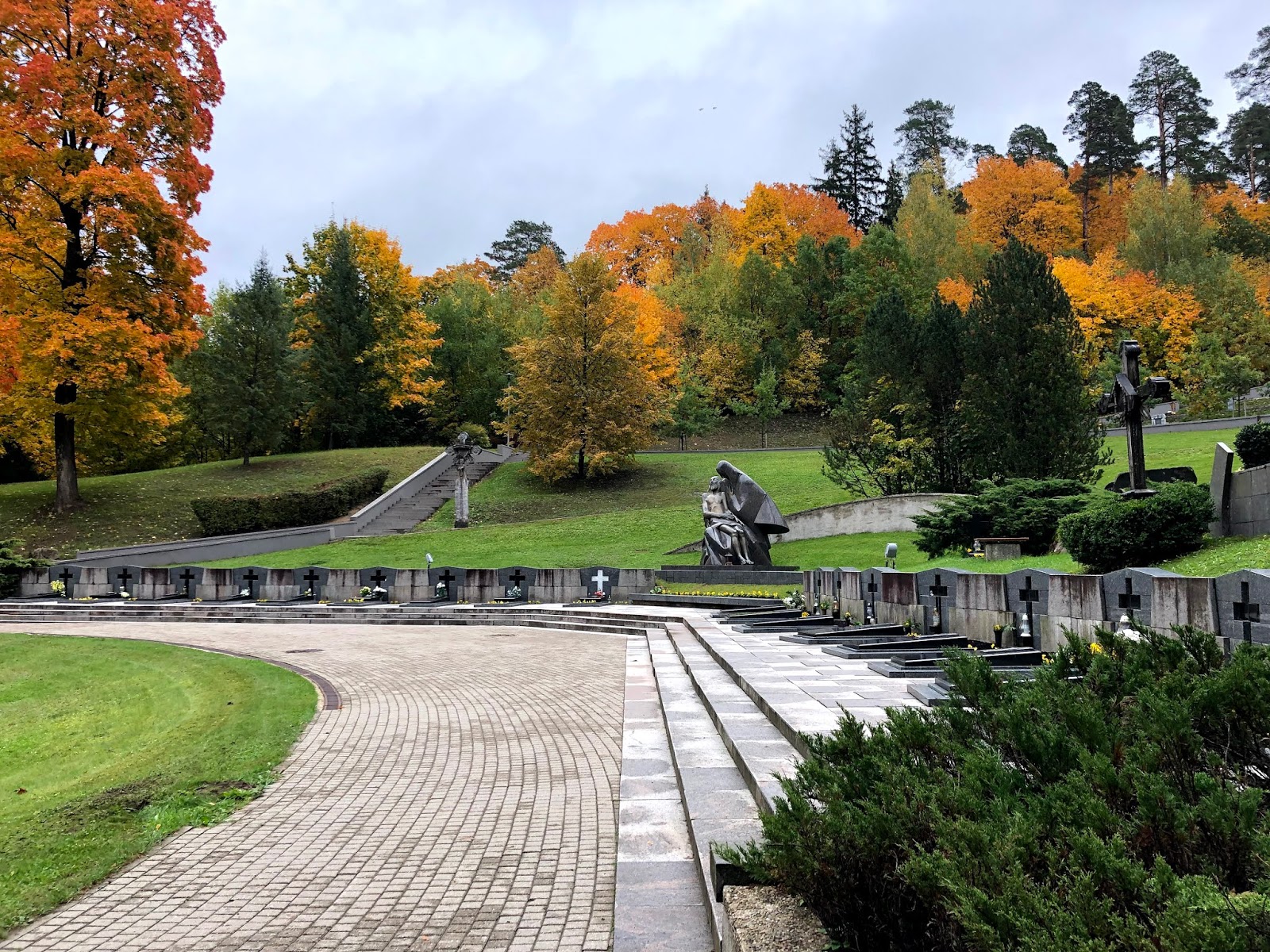
Heroes of Lithuanian independence
This morning we walked back up the hill behind our car park, this time to a flat hilltop which proved to be an excellent place for a game of ball for Max and Elsa. Only on leaving did we see a sign saying no dogs, but the presence of dog poo bins suggests an on-going battle between archeological regulations and municipal pragmatism. From here it was a short drive to the Antakalnio cemetery, where we were to pick up the story of Lithuania's battle for independence. After Lithuania declared its independence in March 1990, it was instructed by the Soviet Union to renounce its decision - a freedom that was only intended for Soviet satellite states, not those which were part of the Soviet Union. Lithuania declined, and the tanks came rolling in, killing nine peaceful protesters at a television station in January 1991, and eight border guards later that year. Those seventeen people are buried in matching graves, now heroes of the state. Remarkably, they were the only people to die in the three Baltic States in their battle for independence from the Soviet Union. 

The first president had a lot on his plate
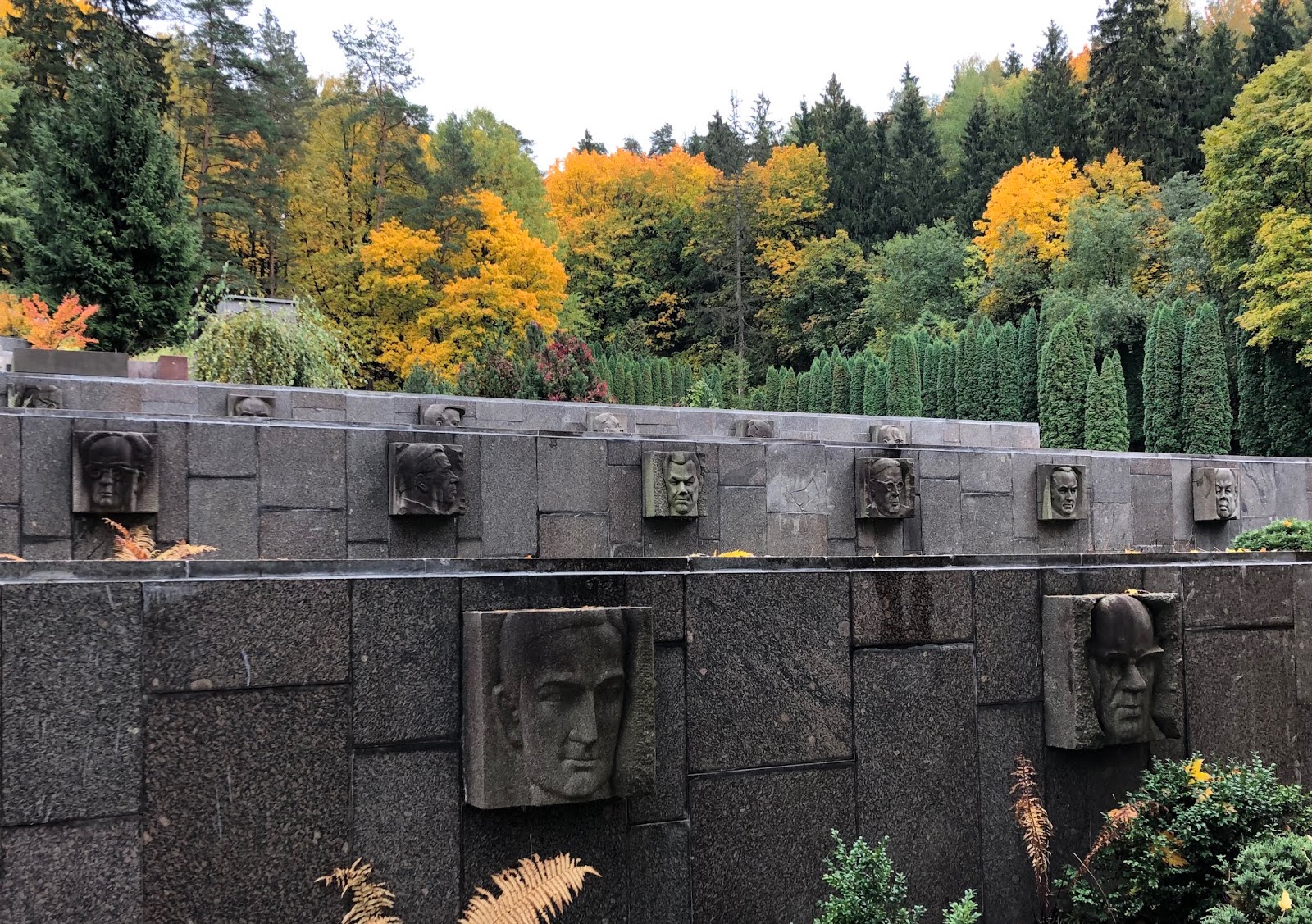
Also buried in Antakalnio are the remains of soldiers in Napoleon's army who perished on the retreat from Moscow, and hundreds of Polish soldiers who died in regional battles between 1919 and 1921. Lithuania's first modern president is buried there, near dozens of Soviet graves with their carved effigies, looking like a stony politburo. And it is still a working cemetery, with regular funerals taking place. Just as well really, as many of the graves have already been engraved with the names of their intended recipients, with open-ended dates, yet to be completed.


The politburo lives - or maybe not

We could have spent the day exploring, but it was time to return to the spaniels, and head to the outskirts of Vilnius, to the town of Trakai. An early Lithuanian king had learned about the lake full of islands, and moved his court there in about 1400 from Kernave, where we'd visited the hill forts a few days ago. A reconstructed castle remains on an island, reachable by wooden bridges, and there are also ruins and other important buildings nearby. We decided not to go inside the castle, but to wander around the grounds, where we were rather startled to suddenly hear the words: "Quiet please!" and find ourselves in the middle of a film set. There was no security, and no-one had questioned us. We beat a hasty retreat across the bridge, to the sound of a busker on a squeezebox, and the familiar sight of people pouring off coaches.


Houses of the Karaite minority
The tourist area now centres on the wooden houses belonging to the Karaite people, a Turkic minority brought from Baghdad as bodyguards around 600 years ago. There are now only about 12 families remaining. Almost as strange a sight for us was the field full of British registered cars in various stages of decay. We've no idea why. Max was more interested in the ducks on the lake. 

There are more ducks tonight, this time back on the Neman river, which we've encountered again on one of its many bends. We are in the spa town of Birštonas, in a car park with good access to walks along the river in the morning, before we head west across the border, and say goodbye to the Baltics, after a month of travelling. Tomorrow also marks three months since we left home. We've seen so much in that time, but there is still a great deal ahead. 


Hey, another dog statue Mum!


Tuesday, 1 October 2019

Rain and gales, a medieval village and a little devilry in Kaunas


Sunday morning was grey but dry so we had the opportunity for a lovely walk along a field path that bordered the River Neman. The night before had been quiet and the early morning was only disturbed by the arrival of local fisherman at the crack of dawn. This was the closest to Russia we had been on this trip, albeit the enclave of Kaliningrad which forms a little Russian island along most of the border between Poland and Lithuania. Formerly known as East Prussia, the Soviet Union managed to hang onto it after WWII and it remained in Russian hands after Lithuania and Poland broke free from communism. Just downstream from where we had parked, the Neman is actually the boundary between the two countries. 
Neri's river
We drove on to Kaunas, Lithuania's second largest city. After topping up with water at a Circle K filling station, we have found them very handy, we parked up close to the river Neris which obviously means Neri's river. We thought the spaniels had probably had enough exercise so we left them in the van and wandered through the lovely old part of the city. Despite the onset of autumn, cafe culture appeared to be alive and well in Kaunas with citizens sitting outside, wrapped up well and enjoying coffee or something a little stronger. 
Plenty of opportunity for pavement grazing in Kaunas


Our ultimate destination was the Museum of Devils, about half a kilometre from the centre and it did not disappoint. Housed in a rather functional building over three floors, it holds over 3,000 sculptures and carvings of devils of one sort or another. Old Nick himself features strongly but demons from a variety of other folk myths and beliefs are on display including India,  Japan, Cuba and Mexico. 

The original collection was started by a local artist Antanas Žmuidzinavičus, a name surely worth a host of points on the Scrabble board. He began collecting in secret in defiance of the Soviet authorities who had a law against religious artefacts. Over the years many other people left gifts of devils to the museum, one of which is a sculpture showing Hitler and Stalin as devils fighting over the bones of Lithuania.


A comment on the Nazi and Soviet occupations of Lithuania
On the way out of Kaunas we paused for one of our routine visits to a laundrette on the outskirts of the city before heading down the A1 motorway to our planned overnight stop. The road down to the lakeside picnic site had been surfaced in the dim and distant past but now contained more potholes that the Peak District so we made zig-zag progress to the lakeside in the gathering gloom. By this time the rain was coming down and the forecast was looking poor so we made the decision to batten down the hatches and stay there for two nights and sit out the rain and gales.

An early walk with the spaniels along a dripping forest track the next morning confirmed that our decision to stay put was the right one. We spent Monday in the van with Neri doing some housekeeping, before planning our route onwards towards Greece, while Nick caught up on some outstanding family history research for a client. Monday night was the windiest we had experienced so far on this trip, with gale-force gusts causing choppy conditions on the lake and bashing against Florence's sides. 


By morning, although the wind was still strong, the rain had blown through and some sunshine was delivered. We set off for Kernavé, now a village but once the capital of the medieval Grand Duchy of Lithuania. It is now a UNESCO World Heritage Site on account of the natural mounds which became hill forts in an area which has been settled since the 9th century BC. 
A neat medieval pig sty

Archaeologists have discovered burial grounds with rich grave goods, and the remains of an ancient town which had completely disappeared. Lithuania resisted the onslaught of Christianity longer than most of Europe and the area represents a period when Paganism finally succumbed to the swords of Christian knights in the early medieval period. The highlight for us was a reconstruction of a 13th century village, complete with houses, workshops and domestic animal shelters. For the spaniels it was a chance for a run off the lead around the towering mounds. 


A kiln for pottery


It would be a brave enemy that stormed this position

In the late afternoon we set off for our overnight stopping place, pausing at a small village supermarket on the way to pick up some much-needed bottles of wine. Shortly after we parked up our evening was enlightened by a fisherman emerging from a small boat on the nearby lake carrying a huge pike, which he proceeded to lift to show us as he passed the van. He looked exceedingly proud, as well he might be, although the pike looked less than happy. We are just yards from what is claimed to be the geographical centre of Europe.  We will walk there tomorrow

The autumn colours here are glorious