Featured post

Follow our travels

If you want to see where we've been, you can use this interactive map. Click on the markers to see more about where we have spent the ni...

Thursday, 15 August 2019

A polar explorer, some laundry and the Hurdy Gurdy ship


We left Henningsvær, fairly promptly. There was nowhere handy to walk the spaniels so we decided to drive back up the narrow, twisting road to the E10 junction where we had seen some possibilities. A walk down a path and a scramble over a few rocks took us down to a sandy beach where, for the first time in ages, we felt confident enough to let the pups off the lead for a game of ball. Unfortunately Elsa approaches a ball in the water in the same way a whale engulfs a shoal of plankton. A quantity of sea water is ingested which, in Elsa's case, results in a delicate tummy, the full results of which we were not to experience for some 14 hours.
It's hard to find a bad view


Back in the van for the short drive to Svolvær where we called in to a motorhome dealer to get some lpg. Autogas for our refillable gas bottle is getting scarcer as we drive north so we try and keep it topped up. We also wanted get some laundry done and buy some groceries. On a trip like this you have to depend on laundrettes for the weekly wash and a good place to find them is on marinas where they cater to the boating fraternity. Luckily there wasn't a queue of people waiting to use the two machines so we were able to chuck everything in and walk to the supermarket. 

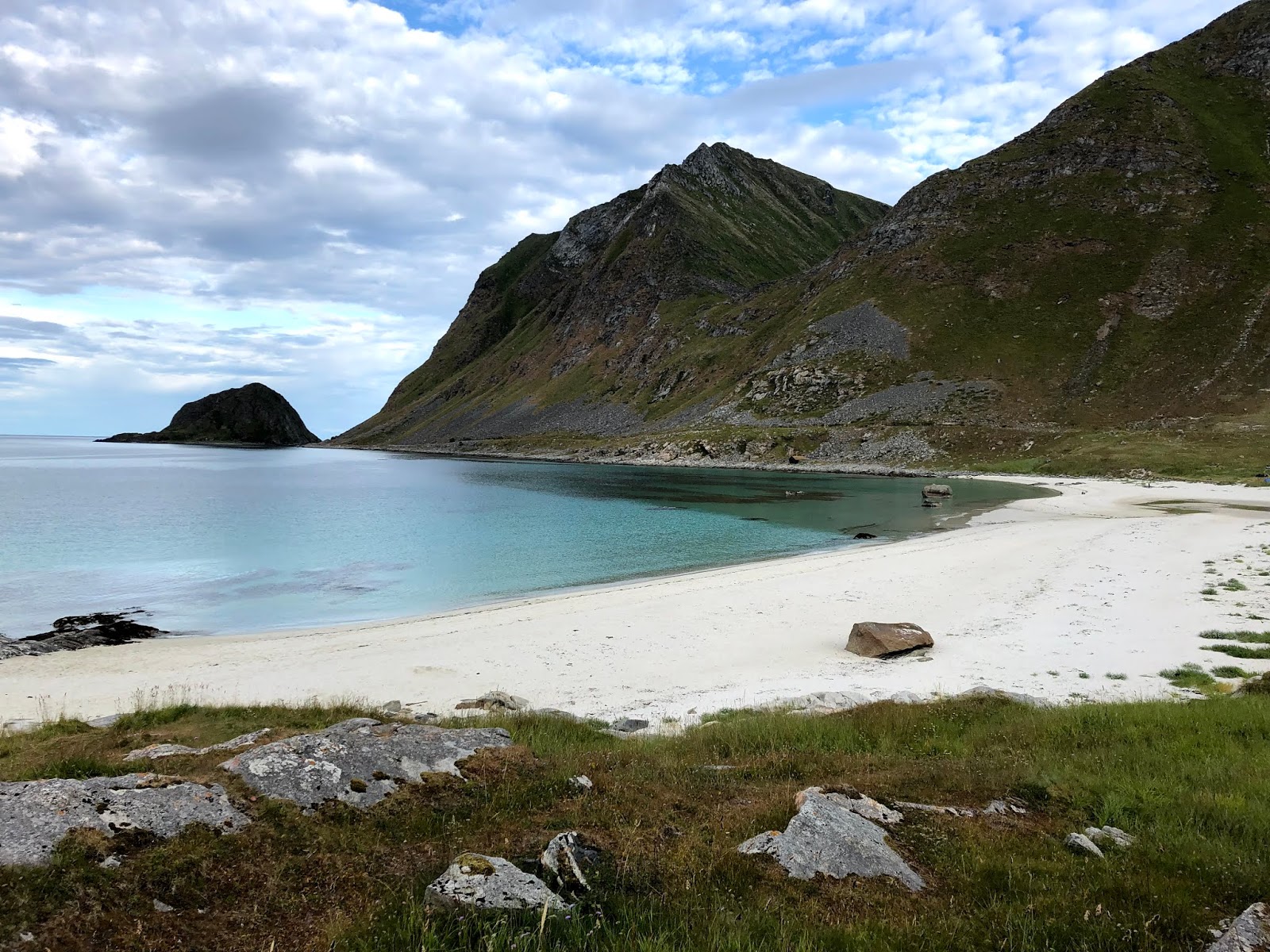
It wasn't big but it was a beach
As I may have mentioned before, food shopping in Norway is not for the light of pocket. If you start to dwell too much on the outrageous prices, you'd come out with nothing. £4 for 200g of cherry tomatoes and £1.25 for a single red pepper soon rattles up the bill. It didn't help that I was determined to try some reindeer, and picked up what I thought was a stewing cut. It turned out to be fillet at £40 a kilo. Oh well. The other problem with Norwegian  supermarkets is the very small range of products they carry. The locals seem to exist on a diet of Tex Mex with shelves groaning under numerous brands of tortillas, taco shells and salsa sauce plus the occasional prawn. 


Hi-tech disposal
A quick call into a garage to fill up with fresh water, Norwegian garages are extremely accommodating in this respect, and it was on to a lay-by where they had a cassette cleaning machine. These miracles of modern technology swallow your toilet cassette, empty it, give it a swill round and then spit it out again. A lady from a Finnish coach was leaning on the door as I approached with a plastic box full of effluent. She moved surprisingly quickly.

It is impossible in Northern Norway to find any overnight spot without an incredible view so we fetched up in a lay-by on the E10 next door to a fjord and surrounded by huge rocky peaks. At around 2am the sea water (see above) finally made its presence known and Elsa woke up and needed to go out. To any passing motorist who spied, in the Norwegian half light,  a British male, wearing just shorts and attached to a dog with a runny tummy, standing by the side of the road, I can only apologise. 


The sun deserted us today
We'd gone to bed after yet another day of 20+ temperatures. Early morning rain heralded an abrupt change in the weather and the temperature plummeted. For the first time since we left home, we had to dig out the waterproofs to walk the dogs. The drive north was through drizzle and low cloud as we headed towards Risøyhamn where we planned to spend the night in a small picnic area decorated with two brightly painted oil drums. Previous visitors had spoken of seeing sea otters but the nearest we got to wildlife were the cases of long-dead sea urchins on the shore which became a source of great fascination to Max. 

Appalling sexual stereotyping
The walk back from the baby supermarket the next morning was enlivened by the arrival of the Hurtigruten ship, Trollfjord. This is one of a fleet of boats, which I have christened the 'Hurdy Gurdy',  that shuttles the full length of the Norwegian coastline carrying cargo, vehicles and passengers to sometimes remote coastal settlements. Each stop gets a daily service, one southbound, and one going north and they are seen as a real lifeline. To boost income they also carry tourists on mini-cruises. It was fun watching this 16,000 tonne ship casually docked as easily as someone parking a car. After a brief ten minute stop to load a couple of cars, and unload a bit of cargo, it was off again, heading south. 

The Hurtigruten arrival 


A remarkable man
With the weather still clamped in we decided to take our time travelling up the scenic coast road to Andenes. We stopped by the village church in Bjørnskinn and found ourselves looking at the grave of Helmer Hanssen. Born in the village he took part in three of Amundsen's Polar expeditions and was one of the first five explorers to reach the South Pole. His biography reads like something out of a Boy's Own paper with a career that also encompassed seal hunting, ice pilot , sled dog driver and ship's captain. His book, The Voyages of a Modern Viking, was published in 1936. 

We took the spaniels for a long walk through a local forest, the only sound being the ringing of the bells tied round the necks of local sheep. This presumably makes them easier to find when the heavy snows hit this part of the world. We enjoyed a nice chat with a local lady who was fetching water for her animals and Neri found out which local berries it was safe to eat, as opposed to the ones that would cause a great deal of unpleasantness. As the rain continued to fall we travelled along the coast road, stopping to walk out to look at a lighthouse. On returning to the car park we discovered that the extremely modern toilets had one-way translucent walls so you could enjoy the view while performing. At least, I hope they were one way.

PS. The reindeer was gorgeous


Monday, 12 August 2019

Slowing down, a run to the beach, and the Venice of the Lofotens


Tonight we are in the stunning fishing village of Henningsvær, the Venice of the Lofotens, which sprawls across several islands, connected to the main road by lofty bridges. Every lay-by on the approach was jammed with vehicles, there were even cars in some of the passing spaces, so when the small car park 30 minutes walk from the village was also jammed, we decided it was time to pay for an overnight. After all, it's been over a week since we last paid, in Trondheim. The motorhome parking area was half empty - there are other, dearer, places in the village for those who can't face the walk - and we were more than happy to stump up £15 for a stunning view and access to Henningsvær, if not much else. Just as well we did, as the parking attendant drove up and checked all the vans within 15 minutes of our arrival.

Worth every penny of £15 for that view

We have covered a grand total of 119km since we left Å on Saturday morning. On the mainland that was a morning's drive, but here the pace is slower, and we want to make the most of our time in the Lofotens, which has long been top of the list of places we want to visit. After being unable to get into the beach parking at Haukland, which has become a bit of a Lofoten version of "The Beach", we spent a quiet night on a hill above, with views across two bays. An added bonus as we settled in was the appearance of two white-tailed eagles soaring overhead on the thermals, and soon a third a short distance away. We watched until we had cricks in our necks, and soon they moved on. 

The Beach, before the hordes arrive
After discovering we were actually in the parking area for a trail head, we decided to take the spaniels for a walk up the hill, promised by the Lofoten tourism site to be "easy to moderate", "a good introduction to hiking for beginners". It was also supposed to be an hour to the top. They did warn that it was "quite steep at the start." "Quite steep" meant 15 minutes of near vertical scrambling through the woods, before the path spat us out onto a heather-covered plateau. Luckily the weather has been dry, so we were able to bounce across bogs that would have devoured the spaniels in spring. We wound our way across the moorland to a rocky knob, where a path could be seen heading fairly directly up the side. Nick and Max were pretty game at first, but eventually the climbing was too much for Max's hip dysplasia, and Nick heroically volunteered to stay with him while Elsa and I struggled on. Alas, before long it was too much for us too, as the scramble needed almost constant three point contact, not easy to achieve with a dog lead in hand. We retreated short of the summit, and the descent from there was tricky enough to confirm we had stopped at the right time. We got back to the van after almost two and a half hours, with two very tired spaniels, and decided to risk staying a second night.

Elsa contemplates the path back down
You have to keep stopping for that view
The code which allows people to park up for an overnight almost anywhere has a few rules. It's should to be at least 150m from a house (we were) and you are only supposed to stay for one night. On the other hand, it was such a quiet spot, and while we had been joined by a couple of other vans, they had moved on. Decision made we had a relaxing afternoon, and Nick did some family history work while I did a couple of jobs around the van, and some advance planning.

The Beach, from the other side

This morning it was an early run down to the beach for me, and a slightly later walk down with the pups. It is a beautiful beach, with fine silver sand, clear water, and soft turf around the edges. On Saturday there had been lots of people on the beach sunbathing, but few in the water. It's easy to forget that we are inside the Arctic Circle, and the water temperature would be no more than 14°C. The weather has continued fair, reaching 23°C here in Henningsvær today, so after a good walk around the village with the spaniels we were tempted by ice-creams on Englishman's Wharf. Brown cheese aside, Norway really does very good dairy products, and the ice-creams were no exception.
Fabulous Olsen's Ices

A very famous football pitch, apparently
It's like this, in every direction


Saturday, 10 August 2019

A life on the ocean wave and lots of dried cod


I've never been a huge fan of islands. It seems to me that many of them have a sometimes tenuous link to the rest of civilisation and are too easily cut off due to the vagaries of weather and transport. When I have found myself on island clusters, whether it be the Scillies or Shetland, I spend time scanning the weather forecasts and the plane timetables, just to ensure that escape is possible if needed. Having witnessed the MS Scillonian rolling while still attached to the quay at St Marys, or the Northlink ferry pitching and tossing at the beginning of the 14 hour trip to Aberdeen, I avoid ferries like the plague.


Is breakfast ready?
However, our visit to the Lofoten Islands, that archipelago of islands and rocks off the north west coast of Norway, did not present a problem. Firstly because the weather, as it has been on almost every day since we entered Scandinavia, was gorgeous. Secondly, and more important from my point of view, a beneficent Almighty has seen fit to join said archipelago to the mainland with a series of bridges and tunnels, so it is possible to get there with dry feet. 

That however necessitates a very long road trip so we boarded the ferry at Bodo for the three and a quarter hour trip to Moskenes, almost the southernmost point of the Lofoten Islands. There had been a gentle nautical build up to this expedition as we had used a number of ferries, albeit relatively short crossings, on our way up the west coast. Luckily the sea was like a mill pond which made up for the fact many of the seats in the lounge were falling to bits.
Å is made for picture postcards


Our voyage followed an overnight in a forested area just outside Bodo, making the journey along twisting roads and through long tunnels from the Svartisen glacier. We did stop off at the little town of Ornes where we walked the spaniels and, in a moment of desperation, having run low on red wine, popped into a branch of Vinmonopolet, the state run off-licence, where a charming assistant relieved me of £33.00 for a 3 litre box of bog-standard Chilean Cabernet Sauvignon. It's little wonder you don't see intoxicated individuals in the streets of Norway, no one can afford to buy any quantity of alcohol.


Cod hang here for three months in the spring
If you have never been to the Lofoten Islands you are missing one of the world's great gems. After disembarking we drove to the small village of Å which is the beginning (or end if you are coming the other way) of the E10 road which runs the length of the archipelago. In the brief summer it plays hosts to a horde of tourists but its main industry is stockfish, the catching and air drying of white fish, usually cod, which is then shipped to southern European countries including Spain and Portugal. We saw piles of it in Portuguese supermarkets when we were there last year where it is called Bacalhau.

Every village we passed has wooden drying racks, known as hjell, on which the fish is hung from February to May, before being moved to indoor drying facilities. We walked the spaniels through one set of these racks, which was a huge mistake, as the ground is covered with decayed fish heads. According to food experts, Norway is the producer of the best stockfish, and it is seen as up there with Italy's parma ham and a well matured cheese.


We desperately tried but failed to find a bad view
We overnighted in the small car park in Å popping down to the artisan bakery in the village which everyone raves about. One rustic barley loaf, a cinnamon bun and a wallet lighter by £11 later, we took the spaniels for a walk on a trail along the edge of a small fjord before heading east. We got in a queue for the service point at Reine and waited impatiently while a French motorhome managed to block all the facilities at once. The man in the German motorhome behind us opined that the French think there are 28 hours in the day, but only work for one of them. We agreed on that, establishing a new link in Anglo-German co-operation
This may have something to do with fish

The beach where we had planned to overnight was packed, we had not bargained for hot sunny weather and the fact it was a Saturday. Instead we drove back along the road and found a beautiful little parking area close to a local hiking route with fantastic views across the fjord. This evening it briefly rained, the first we have had in a month. Next week the forecast is for cooler, wetter weather. I bet Lofoten looks just as stunning in that too. 
The appalling view from tonight's stopover


Wednesday, 7 August 2019

Crossing the line, climbing hills and gazing at glaciers


The Arctic Circle marker
We are now inside the Arctic Circle, although, if you looked at us sitting in shorts having a barbecue in the evening sun, you would only guess that if you squinted behind us to see the ice-blue gleam of the Svartisen glacier. Florence has seldom had a better view for the night. 


We crossed the 66° 33’ line just after one o’clock this afternoon while on the ferry from Kilboghamn to Jektvik. A recorded announcement told us when we had reached the Arctic Circle, gave us some facts and figures, and drew our attention to a hollow globe standing on a promontory to mark the southernmost extent of the midnight sun. 


We were irrationally excited by the moment, which harked backed to tales of “Crossing the Line”, the ceremony held on ships crossing the equator when first-timers were covered in foam and “shaved” by Neptune. No sea-gods appeared, but lots of people discovered how hard it is to take a selfie on a moving boat which captures a very small object in the background.


Yesterday we parted company, for now, with the E6, the road which takes you from the south to the far north of Norway. Instead we are winding our way up the coast on the FV17, otherwise known as Kystriksveien, or the Coast Road. It’s one of Norway’s official scenic routes, and the brochure claims it’s the world’s most beautiful journey. No arguments so far.  As well as spectacular views, the road has regular picnic spots and lookouts, including the one we are in now, and another beautifully manicured area where we spent last night. 

Views from Kystriksveien
Last night’s spot also offered a spectacular walk up the rocky ridge behind us to what we would call a bothy. The trail was well marked - just as well as most of it was across bare rock - and offered plenty of clear, cool rock pools where spaniels could drink and bathe. The rock itself was almost sticky to walk on and free of scree, so there was no fear of slipping and it was an enjoyable experience all ‘round. 

A Norwegian bothy
Wainwright, eat your heart out!
 After our walk we drove on towards Kilboghamn, stopping to admire the view of some of the 40,000 islands and skerries off this coast, and wondering how a Norwegian village came by such an Irish name. We decided against the £12.50 burgers from the shack serving the ferry queue, and managed to convinced the earnest young man taking money that Nick was entitled to a passenger discount as I was actually driving the vehicle - from the right hand side. We have met a couple of earnest young men here, and are still trying to work out how they transform into the relaxed, jovial chaps that seem to predominate among the over fifties.  


Florence doesn't get better views than this
This afternoon another short ferry trip and a few more miles along quiet, but rather narrow roads led us to the Svartisen glacier. It is the second largest in Norway, after Jostedalsbreen, where we were only last week. The finger we can see is  the closest to sea level, and we have spent the evening gazing at it across the fjord, admiring the blues in the ice, and the smooth white of the snow on the ice field above. Norway does have very pretty glaciers. 


Tuesday, 6 August 2019

Brown cheese, the back roads and reflections on Norway


One of the adventures in a foreign country is sailing around a supermarket trying to identify the names on the labels and decipher exactly what we are buying. Having run out of cheese we popped into the shop in Grong and selected a block of something or other labelled 
Gudbrandsdalsost. When we finally unwrapped it we found that it was light brown. Neri assumed it was a wax wrap but it wasn't. It turns out this is a mixture of goat and cow milk with added cream which is then boiled. That releases the natural sugars and caramelises the mixture, hence the brown colour. It is absolutely delicious, particularly as an ingredient of an open sandwich on fresh brown bread. One blog suggested that the way to cheer up a homesick Norwegian in foreign parts, was to offer them a slice. 
Negotiating roads packed with traffic is tedious

We are around half way up Norway and it has made an indelible impression on us. At least one travel writer has called it 'the most beautiful country in the world' and it would be difficult to argue with that opinion. Now we are in the north, away from major towns and cities, every turn in the road brings a new vista of forests, fjords, lakes and mountains. Waterfalls tumble down the sides of sheer rock faces and impossibly wriggly hairpin bends in the road wind their way up and down the landscape.

There are no bad views here
There are downsides. Norway is horrendously expensive. We are beginning to get used to paying the equivalent of £3.40 for a loaf of bread, £2.90 for half a dozen eggs or £2.00 for a litre of milk. We haven't eaten out since we arrived and little luxuries like dark chocolate are now off the menu as it costs £4.00 a bar. We are dreading running out of wine because a bottle of bog-standard Pinot Noir that would cost £8 at home is more than double that here. Part of that is due to wages in Norway, especially at the lower end of the scale being much higher than the UK. Also the fact that taxes are high, all food has 15% VAT added for example, and the Norwegian government slaps massive levies on alcohol. In a country where, in the winter, the sun barely shines between November and January, perhaps that's a sensible idea.

We were able to view the Stone Age carvings on our walk with the spaniels that took us
A deer carved by someone around 5,000 years ago
through some beautiful woodland before we climbed aboard and headed north again on the E6, a road that would eventually take us to Nordkapp. A stop for groceries and we then got some miles under our belt before crossing the border between the region of Trondelag and Nord Norway, marked by a most impressive structure across the road. We overnighted in another picnic area along with another British motorhome, the first we had seen since leaving Trondheim. 

The next morning we negotiated a few miles of roadworks on the way to Mosjoen where there was a service point. The town is overshadowed by a giant aluminium smelting works but also boasts Sjogata, a lovely street lined with the largest collection of listed
Wooden buildings in Mosjoen
wooden buildings in Northern Norway.

Turning off the E6 we went though the longest tunnel we had experienced so far, 7 miles, before we turned onto the 17 road, which is being marketed as a tourist route, much like the NC500 in Scotland. We were not disappointed. The road runs past beautiful fjords, swoops up and down impossible inclines and suddenly disappears into tunnels. Ferries here are part of the road system and we took the boat from Levang to Nesna, a lovely thirty minute trip across a shimmering blue fjord. This was the first ferry on which we were obliged to leave the vehicle and travel on the upper deck, leaving the spaniels to doze in the van.
Regional border signs are so understated
Tonight finds us in an abandoned quarry which the local authority has turned into a motorhome area. Lovely tarmac areas between green grass and stone picnic tables, with a view of the massive escarpment across the fjord in front of us. This evening was enlightened by the arrival of a man on a bicycle, laden with luggage and towing a trailer containing a large husky-type dog. He is apparently attempting to travel around the world with no money. We offered him water but he politely declined and pushed on. We also met a couple from the Lake District, on their way back home. It must be a trial having to go back to work. 
Who knew quarries could be so inviting

Sunday, 4 August 2019

A trundle around Trondheim, and the road to Hell


Trondheim, Norway's third city. It even sounds remote. And in Norway it's considered the north, just as Manchester is to Londoners, despite being less than half way up the United Kingdom. There is a sleeper train from Oslo, which would otherwise be a 500 km drive. Trondheim is at the top of Norway's bulge. From here on, we are travelling through a much narrower country, rarely far from the border with Sweden, and we are still less than halfway from the top.
A quiet country churchyard

We had left our overnight lay-by early, unable to walk the spaniels from there. We stopped soon after in a small village and explored the quiet lanes, admiring the picturesque wooden houses and stopping to get water for the dogs in a sleepy graveyard with an unusual octagonal church. We wanted to be in Trondheim early, as we'd decided to pay to use the town centre motorhome parking, and we'd read that its 50 spaces soon filled up. 
It would cost us 260NOK, (£26) but with the free site closed down there weren't many options.

As I drove into the city in the late morning, Nick read out snippets of information about it. It had pretty much been destroyed by fire at regular intervals from the Middle Ages on, so we weren't expecting to see much in the way of old buildings. Handy tourist maps at the parking site suggested a stroll around the central island, so we set off after lunch. It turned out to be a lovely walk around an elegant town, taking in the harbour along the fjord, then the riverside walk, the northernmost gothic cathedral in Europe, and fabulously colourful warehouses, shops and houses. Apparently the frequent fires had led to a ban on flammable materials being kept on the city side of the river, so warehouses had spring up on the opposite bank, with shops and living accommodation at their rear. Many of these are still there, and the Bakklandet district was a delight.

Houses in Bakklandet, almost in the centre of Trondheim
It's a measure of how small Trondheim is, that we saw the occupants of both of the vehicles with which we'd shared the lay-by the night before. Walking towards the harbour a woman hailed us, and we immediately recognised their dog as belonging to the Czech couple who'd been sleeping in the car behind us. After a laugh and a wave they started to move on, at which point Nick suddenly shouted out: "Great band!" The man and Nick were both wearing Led Zeppelin tops! The next morning I went for a run, and in a quiet car park in a residential area overlooking the fjord I spotted the French family who were squeezing themselves into a VW camper van, and with whom we'd spent a few minutes in the lay-by extolling the many virtues of France for motorhomes. Trondheim will also go down in our diaries as the place we met our first British motorhome travellers since Antwerp (well, one was actually a New Zealander). They stopped by our van for a chat and we exchanged tales of our travels, and discussed the merits of Chausson vans, as they had one too.
A gentle stroll around Trondheim 
We decided to avoid the road to Hell
The next morning we took advantage of what's rumoured to be the most northerly laundrette in Norway, a fifteen minute walk from the motorhome. Some shuttling backwards and forwards was required to get everything washed and dried, but by noon we were pretty much ready to go, and Nick went back to get the van, picking me, the washing and the spaniels up from the side of the road. As we stopped for lunch just outside Trondheim, we realised that the price of fuel had dropped below the magic 15 NOK a litre marker, so we filled the tank. A little later we stopped in Steinkjer, just over the 64th parallel (64 degrees north) to fill up with LPG, and get milk and a few other essentials. Tonight we have stopped in a lovely little carpark, well off the main road, near some Stone Age petroglyphs, and are luxuriating in being empty of everything we need to be empty of (toilet cassette, grey water, recycling) and full of everything else (fresh water, fuel, LPG, clean clothes). It's a good way to be facing the next leg north. Arctic circle, here we come.


The journey so far. We'll be sharing an interactive map soon


Friday, 2 August 2019

418 steps, night time excavations and the goat boat.


We had spent the night in the aquarium car park at Ålesund which furnished our two top requirements when it comes to overnighting. It was quiet and it was free. First thing we took the spaniels down to the neighbouring beach - small but bijou- to give them a bit of a run before anyone else was around. It is illegal to have dogs off the lead in Norway during the summer months to protect wildlife, but the only wildlife we saw was a sleepy female emerging from a tent on the shore, no doubt woken by Elsa's excited barks as we threw the ball for her.                                          

Elsa is not impressed by Trolls
We drove down to the marina and pulled up in the motorhome park overlooking the harbour.We would have paid 250 nok to stay the night here, which we thought was a bit steep, but were happy to pay 75 nok for three hours parking while we visited the town. While we breakfasted we watched the marine traffic including the Nordlys, one of the Hurtigruten ships, which regularly plies a route from the far north of Norway to the south, carrying cargo to coastal communities as well as  fare paying passengers. Our attention was caught by a sleek looking vessel with a helicopter on the rear deck which we assumed to be a posh yacht. In fact it turned out to be merely the support vessel for a super yacht which we later saw in the main harbour. It  belongs, apparently, to a Ukranian billionaire named Yuriy Kosiuk. I'm not jealous.


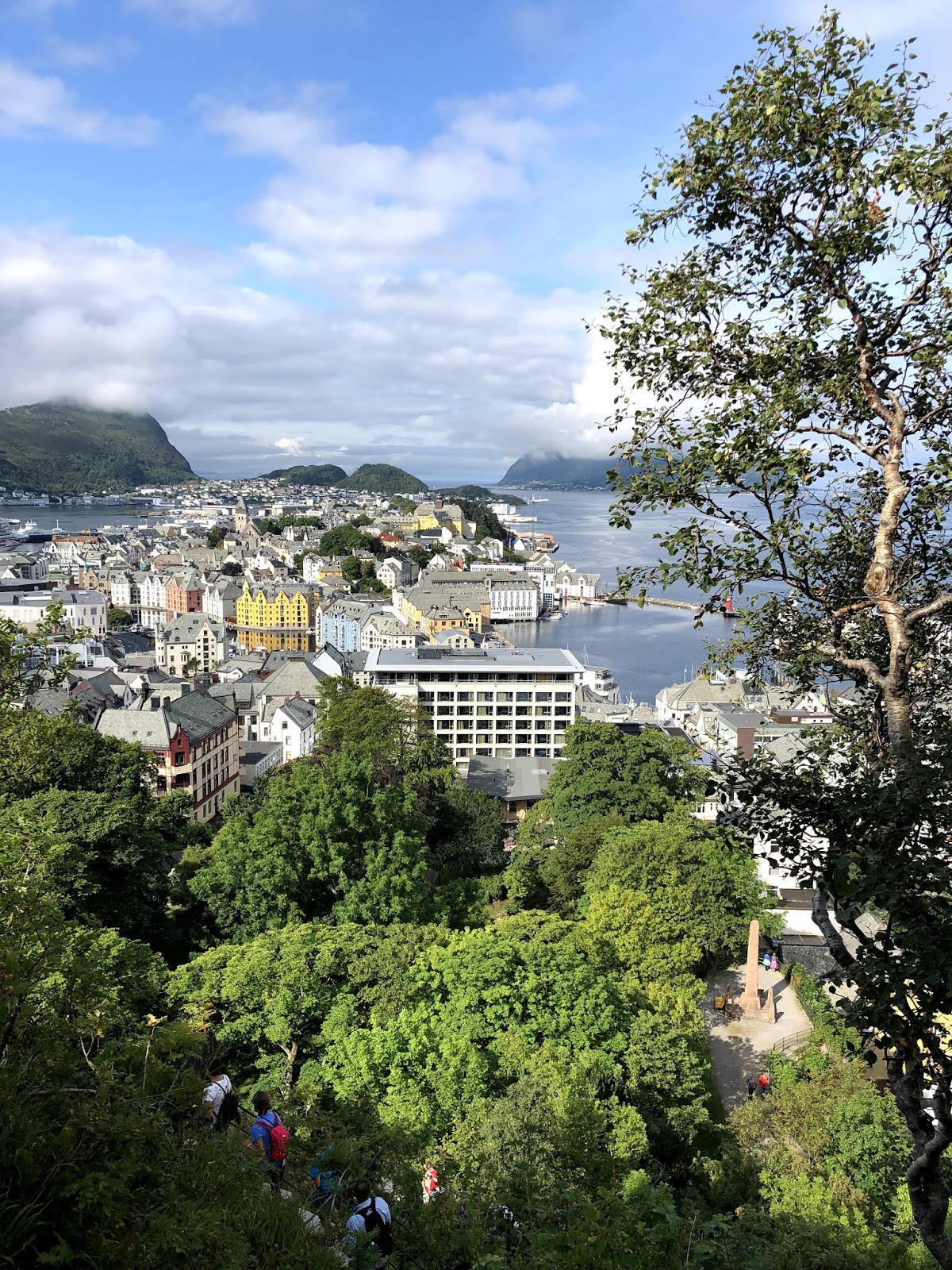
A long climb for a great view
Most of the houses in the old part of Ålesund were built after 1905, for the simple reason that a huge fire destroyed most of the town, then mainly constructed with wood, the year before. Many of the current buildings are constructed in the Art Nouveau style. I had anticipated a gentle walk around the town but instead found myself at the foot of the 418 steps leading up to Aksla, the town's famous viewpoint. Not only did the steps zig-zag up the side of the sheer rock but they were crowded with tourists who, having disembarked from two monstrous cruise ships, were eager to climb high enough to get a photograph of the floating tower blocks which had conveyed them to the town. The spaniels were useful in carving a path to the top. As people suddenly stood to one side, to avoid stepping on small paws, we followed close behind. The view was, indeed spectacular, with the added bonus of a more gentle, if longer path, to return to sea level.
Peace & quiet....before the machines arrived

From Ålesund it was time to turn north again and we ended up staying in a picnic area close to the small village of Eide, alongside a beautiful fjord, where we anticipated a peaceful night. It was not to be. Around 2 am I was woken by a noise outside and, looking out, I saw a huge machine, covered in flashing amber lights, scuttling backwards and forwards on the road. It turned out the the local highways department seem to have a policy of carrying out a bit of resurfacing in the small hours. Needless to say we didn't rise particularly early.             


In Norway you are never far from water
I was preparing breakfast while Neri was on a morning run when I was called by an elderly lady who was sitting at one of the picnic tables with her grandchild together with a small dog. She was keen to know where we were from and got very excited when I told her we lived not far from Manchester. It turned out that the current Manchester United manager, Ole Gunnar Solskjær came, she said pointing vaguely across the fjord, from 'just over there'. Just over there turned out to be Kristiansund some 48km away but he had managed her local club at Molde so was seen as a local boy. She delighted in telling me that she had once met 'super-sub's' mother. 

The Atlantic road switch backs across a string of islands
Having walked the spaniels on a path alongside the fjord it was back in the van for a journey along Norway's Atlantic Road. This stunning highway is built  on several small islands and skerries which are connected by a series of causeways and eight bridges—the most prominent being Storseisunet Bridge. On a beautiful warm sunny afternoon the drive is idyllic but I guess that, being exposed to the North Atlantic, it could get pretty blowy in winter. The road ended at the Atlanterhavstunnelen a 5.7 km excavation that runs under the Bremsnesfjorden and is one of the deepest sub-sea tunnels in the world. I could tell that from the way the road plunged down under Florence's bonnet as we passed the portico. 

A ferry crossing gives us a chance to check the roof
One more ferry crossing and we arrived at our overnight stop in the district of Halsa. An information board near our parking spot tells us that it is the home of the goat boat, (geit boat in Norweigan) a design of small wooden boat that has barely changed since the 16th century. Its curious name comes from its ability to climb waves, just like a goat. Back in 2014 the Norwegian Technology Research Institute pitted this relic of the middle ages against a modern design. It turned out that the goat boat was faster, easier to row and steer, especially in strong winds. Sometimes older is better. 
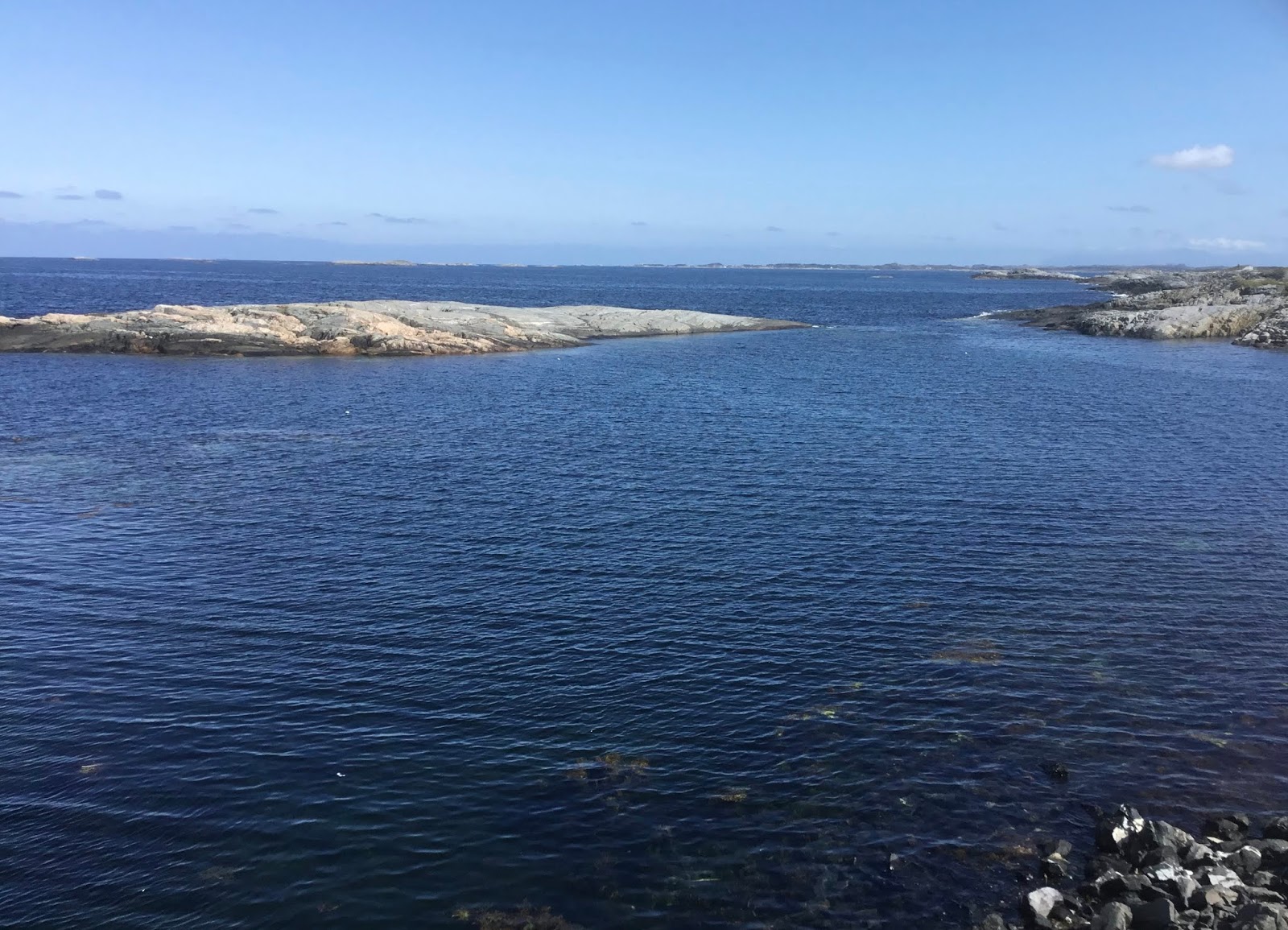
The North Atlantic in benign mood